

Achieving the perfect kitchen knife edge hinges on the correct sharpening angle. This guide, updated for 2026, breaks down how to identify and maintain the ideal angles for various knife types, from delicate paring knives to robust chef’s knives. By understanding and applying these techniques, you’ll drastically improve your cutting efficiency and safety, ensuring your tools perform at their best.
What Angle Should a Kitchen Knife Be Sharpened
Welcome to your ultimate guide for 2026 on the art of sharpening your kitchen knives! A dull knife isn’t just frustrating; it’s dangerous. When a knife isn’t sharp, you have to apply more pressure to cut. This increases the chance of the knife slipping, leading to accidents. But fear not! With the right knowledge about sharpening angles, you can transform your dull blades into precision instruments. In this guide, we’ll delve into the specifics of what angle your kitchen knife should be sharpened at, ensuring optimal performance and safety for every culinary task.
Key Takeaways
- The Ideal Angle Varies by Knife Type: Different knives require different angles due to their intended use and steel type.
- Japanese Knives: Typically sharpened at a lower angle (10-15 degrees per side) for extreme sharpness.
- Western Knives: Generally sharpened at a higher angle (15-20 degrees per side) for durability and versatility.
- Chop/Cleaver Knives: Often benefit from a slightly wider angle for added strength to prevent chipping.
- Consistency is Crucial: Maintaining a steady angle throughout the sharpening process is more important than the exact degree.
- Use Angle Guides or Jigs: For beginners, angle guides or sharpening systems are excellent tools to ensure consistency.
- Test the Edge: A simple paper test is a good indicator of a sharp edge.
Understanding Sharpening Angles: The Basics
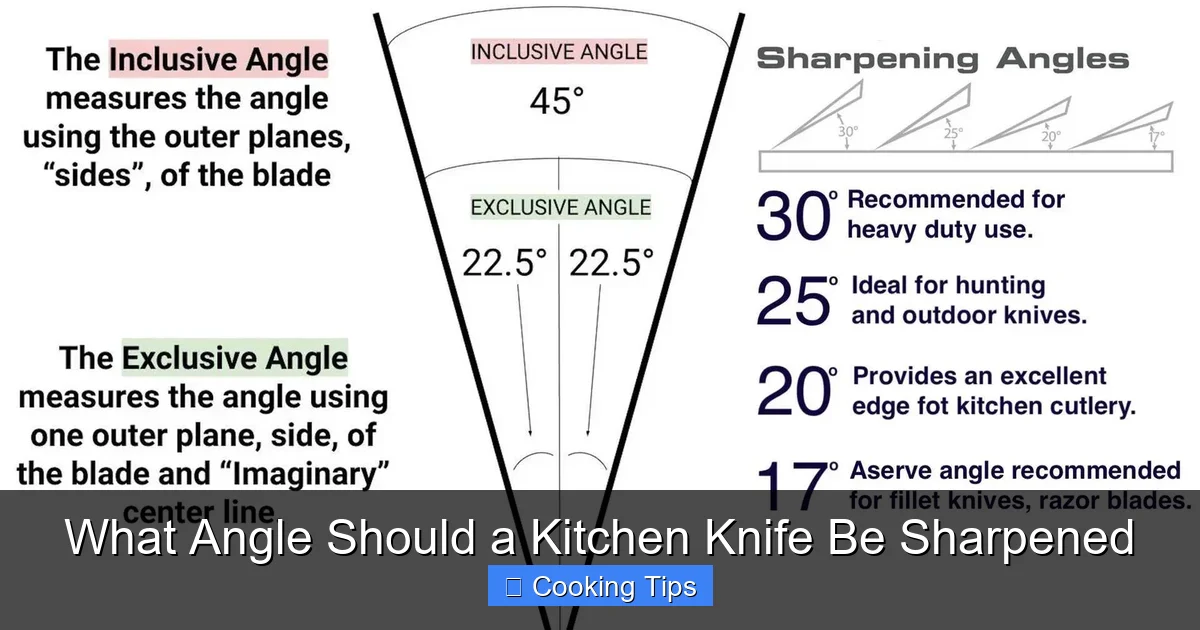
Before we get into the specifics, let’s clarify what a sharpening angle refers to. When you sharpen a knife, you’re essentially creating a new, fine edge by removing small amounts of metal from the blade’s bevel. The angle is the degree at which this metal is removed. It’s usually measured as degrees per side. So, a 20-degree angle means 20 degrees on one side and 20 degrees on the other, for a total edge angle of 40 degrees.
Why Angles Matter
The angle you choose impacts the knife’s performance in two key ways: sharpness and durability.
* Sharpness: A lower angle creates a finer, more acute edge. This means the knife will cut more easily through delicate ingredients and feel incredibly sharp.
* Durability: A higher angle creates a more robust, stronger edge. This edge is less likely to chip or roll, making it ideal for tougher tasks and for knives that see heavy use.
Deciphering Knife Types and Their Angles
Visual guide about What Angle Should a Kitchen Knife Be Sharpened
Image source: kitchenadvising.com
The world of kitchen knives is diverse, and so are their ideal sharpening angles. We can broadly categorize them into two main styles: Japanese and Western.
Japanese Knives: Precision and Finesse
Japanese knives are renowned for their exceptional sharpness and refined cutting ability. They are typically constructed from harder steel, which allows them to hold a very fine edge.
* Ideal Angle: For most Japanese knives, including Gyutos, Santokus, and Nakiris, the recommended sharpening angle is between 10 to 15 degrees per side. Some very specialized Japanese knives might even go as low as 8 degrees.
* Why this angle? This acute angle allows these knives to glide through food with minimal effort. The harder steel used in Japanese knives can support this fine edge without easily chipping, provided they are used with care and on appropriate surfaces (like wood or bamboo).
* Practical Tip: When sharpening a Japanese knife, focus on maintaining this narrow angle consistently. You’ll notice a dramatic difference in how cleanly it slices.
Western Knives: Versatility and Strength
Western-style knives, like the classic Chef’s knife, utility knife, and paring knife, are designed for a wider range of tasks and are often made from slightly softer steel than their Japanese counterparts.
* Ideal Angle: For Western knives, the standard sharpening angle is usually between 15 to 20 degrees per side. Many users find 17 to 20 degrees to be a sweet spot for a good balance of sharpness and durability.
* Why this angle? This slightly wider angle provides a more robust edge that can withstand chopping through bones (though not recommended for most chef’s knives) or working with tougher ingredients without damaging the blade. It’s a more forgiving angle for everyday kitchen tasks.
* Practical Tip: If you’re unsure about your knife’s origin or its intended use, aiming for a 20-degree angle per side is a safe bet for most Western-style kitchen knives.
Special Considerations for Specific Knives
Visual guide about What Angle Should a Kitchen Knife Be Sharpened
Image source: hellskitchenrecipes.com
Beyond the broad Japanese and Western categories, some knives have unique needs.
Paring Knives
These small, nimble knives are used for detailed work like peeling and trimming.
* Angle: Generally, paring knives benefit from a slightly finer edge for precision. If it’s a Japanese-style paring knife, stick to the 10-15 degree range. For Western-style paring knives, 15-20 degrees is appropriate.
Serrated Knives
Serrated knives, like bread knives, are a different beast entirely. They don’t have a traditional bevel that you sharpen in the same way.
* Sharpening: Sharpening serrated knives usually requires specialized tools like a ceramic rod or a diamond file that can hone the individual “teeth” of the blade. The angle here is less about a uniform bevel and more about following the existing serrations. Many people opt to send these out for professional sharpening or use dedicated serrated knife sharpeners.
Cleavers and Heavy-Duty Knives
Knives designed for chopping through tougher materials often require a stronger edge.
* Angle: For these, a slightly wider angle, perhaps even up to 22-25 degrees per side, can be beneficial to prevent chipping. However, for most home cooks, sticking to the 20-degree standard for Western knives will suffice.
How to Achieve and Maintain the Correct Angle
Visual guide about What Angle Should a Kitchen Knife Be Sharpened
Image source: c8.alamy.com
Knowing the ideal angle is only half the battle. The real skill lies in consistently applying that angle during sharpening.
Methods for Sharpening
There are several popular methods for sharpening knives, each with its own approach to angle control.
* Sharpening Stones (Whetstones): This is the traditional and most versatile method.
* Using Stones: You’ll need to learn to hold the knife at a consistent angle against the stone.
* Angle Guides: Many sharpening systems come with angle guides that clip onto the spine of the knife, helping you maintain the correct angle.
* Tape Method: Some people use masking tape on the spine of the knife to build up a slight angle guide.
* Practice: The best way to learn is through practice. Start with an inexpensive knife to hone your technique.
* Electric Sharpeners: These are convenient but offer less control.
* Built-in Guides: Most electric sharpeners have pre-set angle guides. You’ll need to choose a sharpener that matches the angle requirements of your knives (e.g., one with settings for both 15 and 20 degrees).
* Read Instructions: Always follow the manufacturer’s instructions carefully.
* Pull-Through Sharpeners (Manual): Similar to electric sharpeners in offering pre-set angles.
* Versatility: Look for models with multiple slots for different angle preferences if you own both Japanese and Western knives.
The Paper Test: A Quick Sharpness Check
Once you think you’ve achieved a good edge, it’s time to test it.
* How to do it: Take a piece of standard printer paper. Hold it vertically by one edge. Attempt to slice through the paper with your knife, starting from the top.
* What to look for:
* Sharp knife: Will slice through the paper cleanly and smoothly with little to no resistance.
* Dull knife: Will snag, tear, or fold the paper, requiring significant force to make a cut.
Troubleshooting Common Sharpening Issues
Even with the best intentions, you might encounter problems.
* Uneven Edge: This usually happens when your angle isn’t consistent. Try using angle guides or practicing with more focus.
* Rolled Edge: This means the edge is bending over, not staying sharp. It can happen with very fine angles on softer steel or if you’re applying too much pressure. Try a slightly higher angle or a harder steel knife.
* Chipping: This is common with very fine angles on harder steels, especially if the knife is used on hard surfaces or for heavy chopping. Consider a slightly wider angle for that particular knife or its intended use.
Conclusion
Choosing the right sharpening angle is fundamental to keeping your kitchen knives in top condition. For the discerning cook in 2026, understanding that Japanese knives thrive at 10-15 degrees per side and Western knives at 15-20 degrees per side will elevate your culinary experience. Remember, consistency in your angle is paramount, and practice makes perfect. By investing a little time and attention into sharpening your blades correctly, you’ll not only make your cooking easier and more enjoyable but also significantly enhance your safety in the kitchen. So, grab your stones, find your angle, and get ready to slice with confidence!
