

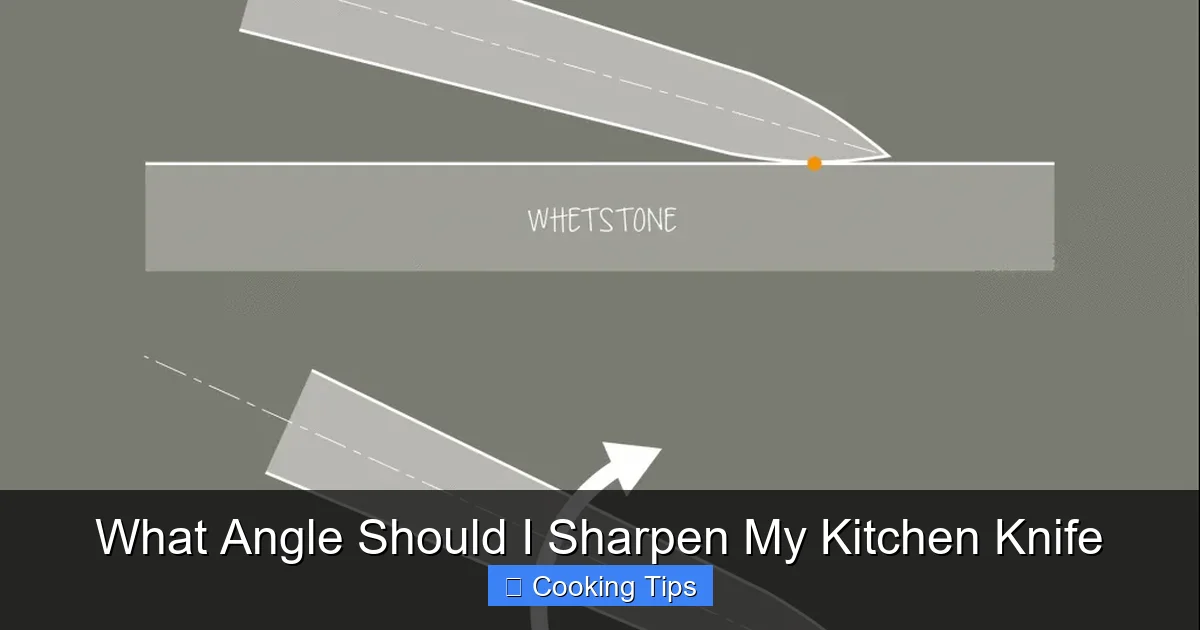
Choosing the right sharpening angle is crucial for a perfectly honed kitchen knife. This guide will demystowledge the mystery, explaining the optimal angles for various knife types, from delicate paring knives to robust chef’s knives. By mastering these angles, you’ll achieve superior cutting performance and extend the life of your valuable cutlery.
## What Angle Should I Sharpen My Kitchen Knife?
Welcome to the ultimate guide to sharpening your kitchen knives! If you’ve ever struggled with a dull blade that just won’t slice cleanly, you’re in the right place. A sharp knife isn’t just about convenience; it’s about safety and efficiency in the kitchen. And the secret to achieving that coveted razor edge? It all comes down to the sharpening angle.
In this guide, we’ll demystify the world of knife sharpening angles, helping you understand what they are, why they matter, and most importantly, what angle you should use for each of your kitchen knives. By the end, you’ll have the knowledge to transform your dull blades into precision cutting tools.
### Why Does the Sharpening Angle Matter?
Think of the sharpening angle as the angle at which the two bevels (the sloped surfaces that form the cutting edge) meet. This angle directly impacts two critical aspects of your knife’s performance: its sharpness and its durability.
* **Sharpness:** A narrower angle creates a finer, more acute edge. This means your knife will slice through food with less resistance, making delicate tasks easier and achieving cleaner cuts. However, this finer edge is also more delicate and prone to chipping or rolling.
* **Durability:** A wider angle creates a more robust, stronger edge. This edge can withstand more pressure and is less likely to get damaged during heavy-duty tasks. The trade-off? It won’t be as exceptionally sharp as an edge with a narrower angle.
So, the “best” angle isn’t a one-size-fits-all answer. It’s a balance between how sharp you need your knife to be and how much abuse it can handle.
### Understanding Knife Types and Their Angles
The type of knife you’re sharpening, its intended use, and the steel it’s made from all play a role in determining the ideal sharpening angle. We can broadly categorize knives into two main groups: Japanese and Western.
#### Japanese Knives: Precision and Finesse
Japanese knives are renowned for their incredible sharpness and precision. They are often made from harder steel than their Western counterparts, which allows them to hold a very acute edge. Because of this, Japanese knives typically require a narrower sharpening angle.
* **The Ideal Angle:** For most Japanese knives, including Gyutos, Santokus, Nakiris, and Yanagibas, an angle of **10 to 15 degrees per side** is recommended.
* **Why this angle?** This acute angle takes advantage of the hard steel, creating an exceptionally keen edge that excels at slicing and fine dicing. It’s perfect for tasks where precision is paramount, like filleting fish or thinly slicing vegetables.
* **What to expect:** Knives sharpened at this angle will feel incredibly sharp, slicing through tomatoes with ease and barely disturbing the skin of an onion. However, this edge requires a bit more care to prevent chipping.
#### Western Knives: Versatility and Robustness
Western-style knives, like your everyday chef’s knife, utility knife, and paring knife, are designed for a wider range of tasks and tend to be made from slightly softer steel. This means they can handle more general kitchen abuse while still maintaining a good level of sharpness.
* **The Ideal Angle:** For most Western knives, an angle of **15 to 20 degrees per side** is the sweet spot.
* **Why this angle?** This broader angle provides a good balance between sharpness and durability. It’s robust enough for chopping tougher ingredients like root vegetables or poultry bones, while still offering a satisfyingly sharp edge for everyday food preparation.
* **What to expect:** A knife sharpened at this angle will be very capable of handling most kitchen tasks. It’s a great all-around performer that won’t be overly delicate.
#### Specific Knife Types and Angles
Let’s break it down further for some common knife types:
* **Chef’s Knife (Western):** 15-20 degrees per side. This is your workhorse, so durability is important.
* **Santoku (Japanese):** 10-15 degrees per side. Designed for precise slicing and dicing.
* **Paring Knife (Western or Japanese):** 10-15 degrees per side. Often used for intricate tasks where a sharper edge is beneficial.
* **Utility Knife (Western):** 15-20 degrees per side. A good all-rounder for various tasks.
* **Boning Knife (Western):** 15-20 degrees per side. Needs to be sharp but also durable enough to navigate bones and joints.
* **Bread Knife (Serrated):** This is where things get different. Bread knives have serrations, which are individual teeth. You don’t sharpen the entire bevel at a consistent angle. Instead, you use a specialized sharpening tool (like a ceramic rod or a tapered sharpening steel) to sharpen each individual tooth. The angle here is dictated by the existing angle of the serrations themselves, which can vary. It’s often a very narrow angle.
### How to Achieve the Correct Angle
Now that you know the ideal angles, how do you actually achieve them when sharpening? This is where your sharpening tool comes into play.
#### Using Sharpening Stones (Whetstones)
Sharpening stones are the traditional and often most effective method for achieving a precise edge. They come in various grits (coarseness) and require a bit of practice.
1. **Prepare Your Stone:** If you’re using water stones, soak them in water until the bubbles stop. Oil stones require a light application of honing oil.
2. **Find Your Angle:**
* **Visual Guides:** Many sharpening guides are available that clip onto your knife, indicating the correct angle.
* **The “Matchbook” Trick:** A simple way to estimate is to place a matchbook (or a few coins) under the spine of your knife. This often gets you close to a 15-20 degree angle. For a 10-15 degree angle, you’ll need a thinner shim or to simply eye it more carefully.
* **Feel and Practice:** The best way is to practice. Place the knife on the stone at what feels like the correct angle. Then, try to maintain that angle as you move the blade.
3. **Sharpening Motion:**
* Start with the heel of the blade and stroke towards the tip, maintaining your chosen angle.
* Apply light, even pressure.
* Lift the knife and repeat on the other side of the blade, ensuring you maintain the *same* angle.
* Continue sharpening, alternating sides, until you feel a burr (a slight rough edge) form on the opposite side of the bevel.
4. **Refine the Edge:** Move to finer grit stones to polish and refine the edge.
5. **Deburr:** After sharpening, gently run the knife on a leather strop or the side of a ceramic mug to remove any remaining burr.
#### Using Sharpening Rods or Steels
These are primarily for *honing* or realigning the edge, not for removing significant metal. However, some specialized sharpening rods can be used for sharpening, especially for serrated knives.
* **For Serrated Knives:** Use a ceramic or diamond-coated rod that fits into the gullet (the space between the teeth) of the serration. Move the rod along the edge, following the angle of each serration.
#### Electric Sharpeners
Electric sharpeners are fast and convenient, but they offer less control over the angle and can remove more metal than necessary.
* **Check the Manual:** Most electric sharpeners have pre-set angles. Follow your sharpener’s instructions carefully. Many are designed for Western-style knives with their fixed angles. If you have Japanese knives, an electric sharpener might not be the best choice unless it offers specific angle settings for them.
### Practical Tips for Success
* **Consistency is King:** More important than hitting an exact degree is maintaining a consistent angle throughout the sharpening stroke. An inconsistent angle will result in a jagged, weak edge.
* **Light Pressure:** Let the abrasive do the work. Excessive pressure can damage the edge and the sharpening tool.
* **Burr Detection:** Learning to feel for the burr is a key skill. It tells you you’ve removed enough metal on one side and it’s time to switch.
* **Practice Makes Perfect:** Don’t be discouraged if your first few attempts aren’t perfect. The more you practice, the better you’ll become. Start with a less expensive knife if you’re nervous.
* **Know Your Steel:** Softer steels (like many Western knives) are more forgiving. Harder steels (like many Japanese knives) can chip more easily if you use too fine an angle or too much force.
* **Listen to Your Knife:** If your knife feels like it’s skipping over the stone or not cutting effectively, re-evaluate your angle and pressure.
### Troubleshooting Common Problems
* **The Knife Still Isn’t Sharp:**
* **Angle Issue:** You might not be holding the correct angle, or it might be inconsistent.
* **Not Enough Sharpening:** You might need to spend more time on the stone, especially if the knife was very dull. Ensure you’re forming a burr.
* **Wrong Grit:** You might need to start with a coarser grit if the edge is very damaged or dull.
* **The Knife Chips Easily:**
* **Angle Too Acute:** You’re likely using an angle that is too narrow for the type of steel or intended use. Try increasing the angle slightly (e.g., from 10 to 15 degrees).
* **Hard Steel Issues:** Some very hard steels are inherently more brittle.
* **The Edge Rolls Over:**
* **Angle Too Acute:** Similar to chipping, too fine an angle can lead to the edge bending rather than breaking.
* **Insufficient Honing:** Not properly deburring or honing can leave a weak edge.
### Conclusion
Choosing the right sharpening angle for your kitchen knives is a fundamental step towards achieving a truly sharp and efficient cutting tool. By understanding the difference between Japanese and Western knife angles, and by practicing consistency with your chosen sharpening method, you’ll unlock a new level of culinary enjoyment. Remember, a sharp knife is a safe knife, and a well-maintained blade is a joy to use. So, grab your knives and your sharpening tools, and get ready to experience the difference a perfectly sharpened edge can make!
Key Takeaways
- Understand the Basics: The sharpening angle dictates the edge’s sharpness and durability. Lower angles are sharper but less durable, while higher angles are more durable but less sharp.
- Japanese Knives: Typically require a steeper, more acute angle of 10-15 degrees per side, reflecting their harder steel and focus on precision.
- Western Knives: Generally benefit from a broader angle of 15-20 degrees per side, offering a good balance of sharpness and robustness for general kitchen tasks.
- Serrated Knives: Require specialized sharpening techniques and tools, as their teeth are sharpened individually, not the entire bevel.
- Utility and Paring Knives: Often perform best with slightly sharper angles (around 10-15 degrees) for intricate work, while larger chef’s knives might lean towards 15-20 degrees for versatility.
- Consistency is Key: Maintaining a consistent angle throughout the sharpening process is more important than hitting an exact millimeter measurement.
- Experiment and Adapt: While general guidelines exist, personal preference and the specific knife steel can influence the ideal angle for your needs.
