

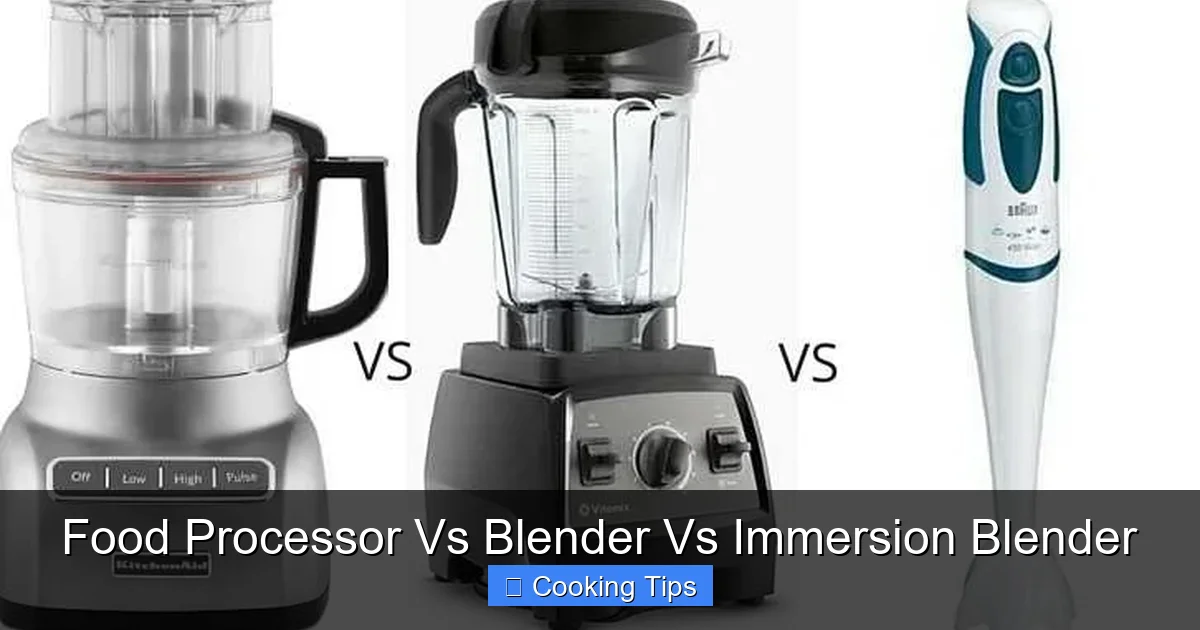
Choosing between a food processor, blender, and immersion blender can be confusing. This guide breaks down their distinct functions, highlighting what each appliance excels at. Whether you need to chop, puree, or emulsify, understanding these differences will help you select the ideal tool for your culinary needs, leading to better results and less kitchen stress.
Navigating the world of kitchen appliances can sometimes feel like a culinary maze. You’re in the middle of making a delicious soup, a vibrant pesto, or perhaps a batch of cookie dough, and you reach for your trusty gadget, only to wonder: is this the *right* gadget? Today, we’re diving deep into the often-confused trio: the food processor, the blender, and the immersion blender. By the end of this guide, you’ll have a crystal-clear understanding of what each appliance is best suited for, how to use them effectively, and when to choose one over the others. Let’s simplify your kitchen toolkit!
## Understanding the Core Differences
At first glance, these machines might seem similar – they all involve spinning blades and processing food. However, their design and intended purpose are quite distinct, leading to different capabilities and ideal applications.
### The Food Processor: The All-Rounder Workhorse
A food processor is essentially a multi-functional kitchen appliance designed for a wide array of food preparation tasks. It typically features a large bowl with a removable blade at the bottom, and it often comes with various discs and attachments for slicing, shredding, grating, and even kneading dough.
#### Key Features and Functions:
* **Chopping and Mincing:** Its primary function. Perfect for onions, garlic, nuts, herbs, and vegetables.
* **Slicing and Shredding:** With the right disc attachment, it can quickly slice vegetables for salads or shred cheese.
* **Pureeing:** While not as smooth as a blender, it can create chunky or smooth purees. Think hummus or baby food.
* **Kneading Dough:** Many food processors have dough blades that can efficiently knead bread or pizza dough. This is a fantastic time-saver compared to traditional kneading. For those who love baking, learning how to make a pie crust in a food processor can revolutionize your pastry game.
* **Emulsifying:** Can help create dressings and sauces.
#### When to Choose a Food Processor:
You’ll reach for your food processor when you need to:
* Prepare large batches of chopped ingredients quickly.
* Achieve consistent textures for dips, spreads, or doughs.
* Perform tasks like shredding cheese or slicing vegetables uniformly.
* Make items like pesto or hummus, where a slightly coarser texture is often desired. For instance, making pesto sauce without a food processor is possible but often less efficient and yields a different texture.
### The Blender: The Master of Liquefaction
A blender, typically with a tall jar and a fixed set of blades at the bottom, is engineered for one primary purpose: to liquefy ingredients. Its powerful motor and fast-spinning blades are designed to create smooth, consistent liquids.
#### Key Features and Functions:
* **Liquefying:** This is its forte. Smoothies, milkshakes, and protein shakes are staples.
* **Pureeing:** Creates incredibly smooth purees, perfect for velvety soups, sauces, and baby food.
* **Crushing Ice:** Many blenders can effectively crush ice for frozen drinks.
* **Making Sauces and Dressings:** Ideal for achieving smooth, emulsified sauces and dressings.
* **Grinding:** Some high-powered blenders can even grind small amounts of dry ingredients like coffee beans, though a dedicated grinder is usually better. Learning if you can use a food processor to grind coffee beans also highlights the different capabilities of these machines.
#### When to Choose a Blender:
Opt for a blender when your goal is:
* Achieving a perfectly smooth, drinkable consistency for beverages.
* Creating silky-smooth soups or sauces.
* Blending ingredients that are mostly liquid.
* Making frozen cocktails or desserts. For detailed guidance, check out how to make a smoothie with a blender.
### The Immersion Blender: The Convenient Stick
The immersion blender, also known as a stick blender or hand blender, is a handheld appliance with a blade at the end of a shaft. It’s designed to be submerged directly into a pot, bowl, or measuring cup, making it incredibly versatile for small jobs and tasks where you want to avoid transferring ingredients.
#### Key Features and Functions:
* **Pureeing Soups and Sauces:** Its most popular use. Blend directly in the pot for easy cleanup.
* **Emulsifying:** Great for making mayonnaise, salad dressings, or vinaigrettes in a small container.
* **Whisking:** Many immersion blenders come with whisk attachments for whipping cream or egg whites.
* **Blending Small Batches:** Perfect for single servings or small quantities where a full-sized blender would be overkill.
#### When to Choose an Immersion Blender:
An immersion blender shines when:
* You need to quickly blend or puree something directly in its cooking vessel (like a pot of soup).
* You are making small batches of sauces, dressings, or dips.
* You want a tool that is easy to store and clean.
* You want to avoid transferring hot liquids to a blender.
## Food Processor Vs. Blender: The Key Distinctions in Action
Let’s get into the nitty-gritty of how these two powerhouses perform different tasks.
### Chopping and Dicing
**Food Processor:** Excellent for uniform chopping. You can control the texture from coarse to fine by pulsing. For example, onions for salsa or vegetables for mirepoix will be consistently diced. The wider bowl allows ingredients to move around, ensuring even processing.
**Blender:** Not ideal for dry chopping. Blades spin too fast and tend to pulverize ingredients rather than chop them cleanly. If you try to chop an onion in a blender, you’ll likely end up with a wet, mushy paste.
### Pureeing
**Food Processor:** Can create purees, but they might retain a slightly coarser texture compared to a blender. This can be desirable for things like hummus or chunky fruit purees.
**Blender:** The king of smooth purees. Its high-speed blades create ultra-fine, velvety textures, perfect for creamy soups, sauces, and baby food. If you want a truly smooth texture, a blender is your best bet.
### Making Doughs and Pastes
**Food Processor:** Many food processors come with a dough blade, making them excellent for kneading bread dough, pizza dough, or creating pastry dough. It handles tasks like making pie crust dough with ease, saving you significant manual effort.
**Blender:** Not designed for dough. The blades can get bogged down, and the friction can overheat the motor. For pastes like nut butters or dips, a food processor generally gives better control over consistency.
### Making Smoothies and Drinks
**Food Processor:** Can make smoothies, but the texture might be slightly less smooth and potentially contain small chunks. It’s more about pulverizing than liquefying.
**Blender:** Superior for smoothies. Its design is optimized to break down fruits, vegetables, and ice into a perfectly smooth, drinkable consistency.
## Immersion Blender Vs. Blender: Convenience and Application
The immersion blender offers a different kind of convenience compared to its countertop cousin.
### Direct Pot Blending
**Immersion Blender:** This is where the immersion blender truly shines. You can blend hot soups, sauces, or purees directly in the pot they were cooked in. This minimizes dishes and avoids the risk of burns from transferring hot liquids to a conventional blender.
**Blender:** Requires transferring hot liquids, which can be dangerous. Additionally, steam can build up in a sealed blender jar, potentially causing accidents.
### Batch Size
**Immersion Blender:** Ideal for small to medium batches. Perfect for blending a single serving of soup or a small batch of dressing.
**Blender:** Better for larger batches. While some personal blenders exist, standard blenders are designed to handle more volume.
### Texture Control
**Immersion Blender:** Offers good texture control for soups and sauces, allowing you to achieve a desired smoothness by blending for longer or shorter periods. However, achieving the ultra-fine, airy texture of some blender-made smoothies might be difficult.
**Blender:** Offers superior control for creating extremely smooth textures, especially for beverages and fine purees.
## When to Use Which: Practical Scenarios
Let’s put theory into practice with some common kitchen tasks.
### Scenario 1: Making Tomato Soup
* **Best Tool:** Immersion Blender.
* Why: You can blend the soup directly in the pot after cooking. It’s quick, easy, and requires minimal cleanup.
* **Alternative:** Blender.
* Why: You can achieve a very smooth, velvety texture. However, you’ll need to let the soup cool slightly before transferring it to the blender and be cautious of steam.
### Scenario 2: Preparing Hummus
* **Best Tool:** Food Processor.
* Why: A food processor can handle the tahini, chickpeas, and other ingredients, creating a smooth yet slightly textured hummus. It has the power to process dense ingredients effectively.
* **Alternative:** Blender (with caution).
* Why: A high-powered blender can make very smooth hummus. However, it might require more liquid and can sometimes be trickier to get all the ingredients to process evenly without stopping and scraping down the sides.
### Scenario 3: Making a Green Smoothie
* **Best Tool:** Blender.
* Why: Blenders are designed to liquefy ingredients and create a smooth, drinkable consistency. They excel at breaking down leafy greens and ice into a uniform mixture.
* **Alternative:** Immersion Blender (less ideal).
* Why: While you could technically blend a smoothie with an immersion blender, achieving a truly smooth texture would be challenging, and it might require a lot of liquid and effort.
### Scenario 4: Shredding Cheese
* **Best Tool:** Food Processor (with shredding disc).
* Why: The dedicated shredding disc attachment on a food processor makes this task effortless and produces uniform shreds.
* **Alternative:** None of the others.
* Why: Blenders and immersion blenders are not designed for shredding. Attempting to do so would likely result in a mushy mess.
### Scenario 5: Kneading Pizza Dough
* **Best Tool:** Food Processor (with dough blade).
* Why: The dough blade and motor are powerful enough to knead dough efficiently in minutes, mimicking the results of hand-kneading.
* **Alternative:** None of the others.
* Why: Blenders and immersion blenders lack the torque and design to handle dough effectively.
## Troubleshooting Common Issues
Sometimes, even with the right tool, things don’t go perfectly. Here are a few common issues and how to address them.
### Food Processor Not Chopping Evenly
* Problem: Ingredients are either too large or turned into a paste.
* Solution:
* Don’t Overfill: Process ingredients in batches if necessary.
* Control Pulsing: Use short pulses for chopping. Pulse, then check the consistency. For finer textures, run the processor for longer.
* Cut Ingredients Uniformly: Ensure larger ingredients are cut into roughly equal-sized pieces before processing.
* Check Blade Attachment: Make sure the blade is securely locked in place.
### Blender Not Blending Smoothly
* Problem: Lumps remain, or the mixture is too thick.
* Solution:
* Add More Liquid: Blenders need sufficient liquid to operate efficiently. Add a little more water, milk, or juice.
* Scrape Down Sides: Stop the blender and use a spatula to push down ingredients that cling to the sides.
* Layer Ingredients Correctly: For best results, add liquids first, then softer ingredients, followed by harder ingredients and ice.
* Allow Motor to Cool: If blending for a long time, allow the blender motor to cool. Overheating can affect performance.
### Immersion Blender Not Pureeing Effectively
* Problem: Chunky bits remain, or the blender struggles to move.
* Solution:
* Ensure Enough Liquid: Like a blender, an immersion blender needs some liquid to work.
* Adjust Depth: Don’t submerge the entire motor housing. Keep the blade submerged, but the main body above the liquid.
* Move the Blender: Move the immersion blender up and down and in a circular motion within the pot to ensure all ingredients are processed.
* Check for Blockages: Ensure no large solids are jamming the blade.
## Cleaning and Maintenance
* **Food Processor:** Usually involves disassembling the bowl, lid, and blade. Most parts are top-rack dishwasher safe, but check your manual. The motor base should only be wiped clean.
* **Blender:** The jar and lid are typically dishwasher safe. The blade assembly in the jar is usually not removable, so rinsing immediately after use is key. Some blender bases have a self-cleaning function. Remember to avoid using the blender with wet hands to prevent shock and ensure the jar is securely locked before operating.
* **Immersion Blender:** The shaft with the blade is usually detachable and dishwasher safe (top rack). The motor unit is wipe-clean only. This is generally the easiest appliance to clean.
## Conclusion: Choosing Wisely for Culinary Success
The food processor, blender, and immersion blender are not interchangeable. Each has a unique role in the kitchen, and understanding their strengths will elevate your cooking.
* **Choose a food processor** for chopping, slicing, shredding, and dough-making.
* **Choose a blender** for creating smooth liquids, smoothies, and purees.
* **Choose an immersion blender** for quick blending directly in pots and for small batch tasks.
By selecting the right tool for the job, you’ll achieve better textures, save time, and enjoy the process of cooking more. Happy blending, processing, and immersing!
- Food processors excel at chopping, slicing, shredding, and kneading dough due to their wider bowls and multiple blade attachments.
- Blenders are designed for liquefying ingredients, creating smooth purees, smoothies, and sauces with their tall jars and powerful, fast-spinning blades.
- Immersion blenders are perfect for quick blending directly in pots or bowls, ideal for soups, sauces, and small batches, offering convenience and easy cleanup.
- Each appliance has specific strengths; using the wrong tool can lead to uneven textures or failed recipes.
- Consider the types of tasks you perform most often in the kitchen when deciding which appliance is best for you.
- Maintenance and cleaning vary significantly between the three, with immersion blenders generally being the easiest to clean.
[FEATURED_IMAGE_PLACEHOLDER]
