

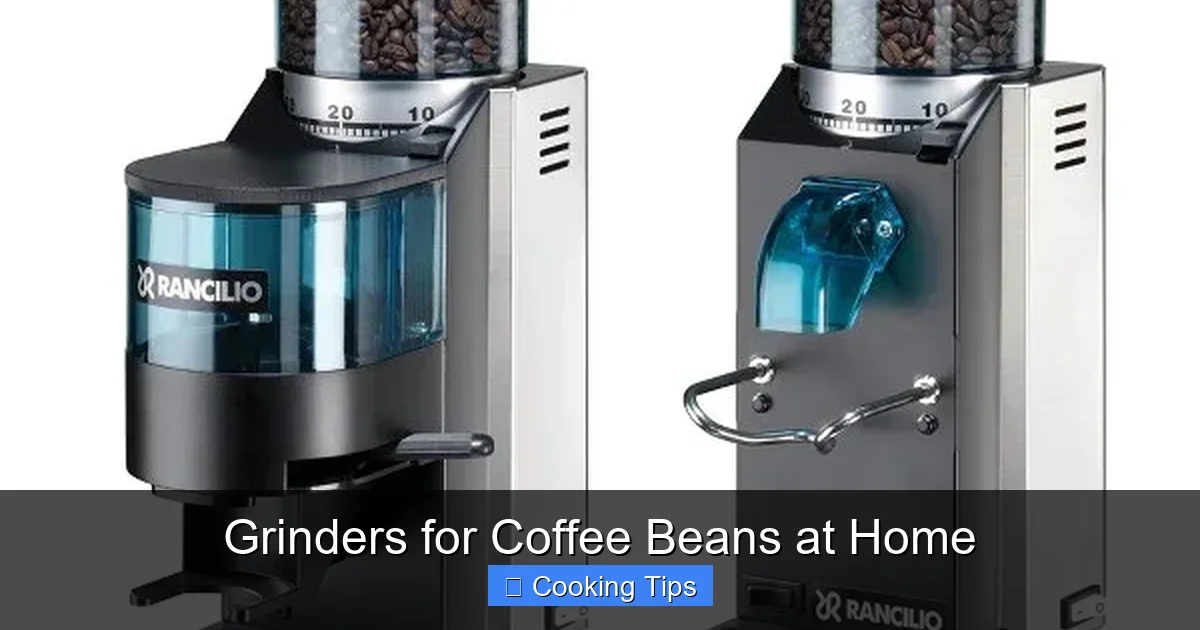
Choosing the right coffee bean grinder is key to unlocking exceptional flavor at home. This guide explores the differences between burr and blade grinders, explains the importance of grind size for various brewing methods, and offers practical tips to ensure you get the most out of your beans. By understanding these aspects, you’ll elevate your home coffee experience.
Welcome, coffee lovers! Are you ready to take your home coffee game to the next level? If you’re still buying pre-ground coffee, you’re missing out on a world of flavor. The secret to truly delicious, aromatic coffee lies in the beans, and just as importantly, in how you grind them. This comprehensive guide will demystify the world of coffee grinders and teach you everything you need to know to grind your coffee beans perfectly at home. We’ll cover the different types of grinders, how to choose the right one for your needs, and why grind size matters so much.
## Understanding Coffee Grinders: The Two Main Types
When it comes to grinding coffee beans at home, there are two primary types of grinders you’ll encounter: blade grinders and burr grinders. Each has its own pros and cons, and understanding the difference is the first step to making an informed decision.
### Blade Grinders: The Budget-Friendly Option
Blade grinders, also known as propeller grinders, work like a blender. They have a spinning blade at the bottom that chops the coffee beans into smaller pieces.
Pros:
- Affordability: Blade grinders are typically much cheaper than burr grinders, making them an accessible entry point for home coffee enthusiasts.
- Simplicity: They are generally very easy to use and require minimal maintenance.
Cons:
- Inconsistent Grind: This is the biggest drawback. The spinning blade chops the beans unevenly, resulting in a mix of fine dust and large chunks. This inconsistency leads to uneven extraction, meaning some coffee particles will be over-extracted (bitter) while others are under-extracted (sour).
- Heat Generation: The high-speed blades can generate heat, which can slightly “cook” the coffee grounds and diminish their flavor.
- Limited Control: You have very little control over the grind size. You can only pulse the grinder for short or long periods, which approximates a grind size rather than precisely setting it.
Who is a blade grinder best for? If you’re on a very tight budget, just starting out, and primarily brew drip coffee or use a French press where some inconsistency is more forgiving, a blade grinder might suffice. However, for those serious about coffee flavor, it’s often recommended to upgrade as soon as possible.
### Burr Grinders: The Professional Choice
Burr grinders use two abrasive surfaces, called burrs, to grind the coffee beans. These burrs crush or grind the beans into uniform particles between them. There are two main types of burr grinders: conical burr grinders and flat burr grinders.
Conical Burr Grinders: These have a cone-shaped inner burr that rotates against a ring-shaped outer burr. They are known for their efficiency and relatively quiet operation.
Flat Burr Grinders: These have two flat, parallel discs with interlocking teeth. They are often found in high-end espresso grinders due to their precision and ability to produce very uniform grounds.
Pros:
- Consistent Grind Size: This is their superpower. Burr grinders produce uniform coffee particles, which is essential for even extraction and the best possible flavor.
- Precise Control: You can precisely adjust the grind size, from very coarse for French press to very fine for espresso. This control allows you to tailor the grind to your specific brewing method.
- Less Heat: Burr grinders operate at lower speeds and generate less heat, preserving the delicate aromas and flavors of the coffee beans.
- Durable: High-quality burr grinders are built to last.
Cons:
- Cost: Burr grinders are generally more expensive than blade grinders, though there’s a wide range of prices available.
- Maintenance: They require more thorough cleaning than blade grinders, though it’s usually not a complicated process.
Who is a burr grinder best for? Anyone who wants to improve their coffee, from drip coffee drinkers to espresso aficionados. If you care about the taste of your coffee and want to experiment with different brewing methods, a burr grinder is a worthwhile investment.
## The Importance of Grind Size for Brewing
Grind size is arguably the most critical factor in achieving a delicious cup of coffee. It dictates how quickly water can extract flavor from the coffee grounds. The relationship between grind size and brewing time is crucial.
Coarse Grind (like sea salt)
Best for:
- French Press: The long steep time in a French press requires a coarse grind to prevent over-extraction and bitterness.
- Cold Brew: Similar to French press, cold brew relies on a long steeping time, so a coarse grind is ideal.
- Percolator: While not as common, a coarse grind is also recommended for percolators.
A coarse grind allows water to flow through the grounds relatively quickly, providing a balanced extraction for methods with longer contact times.
Medium Grind (like sand)
Best for:
- Drip Coffee Makers: Most standard automatic drip coffee machines work best with a medium grind.
- Pour-Over (like Chemex or V60): For these methods, a medium to medium-fine grind is often preferred, depending on the specific brewer and pour technique.
- Aeropress (longer brew times): If you use the Aeropress with a longer steep time, a medium grind can be suitable.
This is the most versatile grind size, suitable for many popular brewing methods. It offers a good balance between surface area and water flow.
Fine Grind (like table salt)
Best for:
- Espresso: Espresso machines use pressure and a short brew time, requiring a fine grind to allow for proper extraction and to create the characteristic crema.
- Moka Pot: These stovetop brewers also benefit from a fine grind, though slightly coarser than espresso.
- Aeropress (shorter brew times): For quicker Aeropress brews, a fine grind is often used.
A fine grind has a larger surface area, allowing for rapid extraction of flavor compounds in a shorter amount of time.
Extra Fine Grind (like powdered sugar)
Best for:
- Turkish Coffee: This traditional method requires an extremely fine grind that dissolves into the water.
This is the most challenging grind to achieve consistently, even with high-end grinders.
What Happens If Your Grind Size is Wrong?
- Too Coarse: Water flows through the grounds too quickly, resulting in under-extraction. Your coffee will taste weak, sour, and lack depth.
- Too Fine: Water struggles to flow through the grounds, leading to over-extraction. Your coffee will taste bitter, harsh, and astringent.
Achieving the correct grind size is essential. It’s a fundamental aspect of controlling the extraction process. If you’re struggling with your coffee tasting off, adjusting your grind size is often the first and most effective solution.
## How to Choose the Right Coffee Grinder
With so many options, choosing a grinder can feel overwhelming. Here’s a breakdown to help you decide:
1. Consider Your Brewing Methods
What kind of coffee do you typically brew?
- Drip Coffee / French Press: A mid-range burr grinder will serve you very well.
- Espresso: You’ll need a higher-quality burr grinder with very precise adjustment capabilities. Espresso requires a fine and extremely consistent grind.
- Variety of Methods: A versatile burr grinder with a wide range of settings is ideal.
2. Set Your Budget
Blade Grinders: $20 – $50
Entry-Level Burr Grinders: $70 – $150 (Good for drip, French press, Pour-over)
Mid-Range Burr Grinders: $150 – $300 (Excellent all-around, some capable of decent espresso)
High-End Burr Grinders: $300+ (Excellent for espresso and all other methods, highly durable)
While it’s tempting to go for the cheapest option, remember that a good burr grinder is an investment that will significantly improve your coffee for years to come. Think of it as a crucial component in your coffee setup, much like a good kettle or your favorite brewing device.
3. Manual vs. Electric
Manual Grinders: These require you to crank a handle to grind the beans. They are often more affordable than electric burr grinders and can produce a very consistent grind. They are also great for travel and for those who enjoy a more hands-on approach.
- Pros: Portable, quiet, affordable (for quality ones), good grind consistency.
- Cons: Requires physical effort, slower than electric.
Electric Grinders: These are convenient and fast. As discussed, burr electric grinders are preferred for quality. Blade electric grinders are the cheapest but least effective.
- Pros: Fast, convenient, less effort.
- Cons: Can be more expensive, require power.
4. Ease of Cleaning and Maintenance
All grinders will need cleaning. Look for models that are easy to disassemble and clean. Coffee oils can build up over time and impart rancid flavors to your fresh grounds. Regular cleaning is essential for great-tasting coffee.
## Grinding Your Beans at Home: Step-by-Step
Once you’ve got your grinder, it’s time to put it to work! Here’s how to grind your coffee beans for the perfect cup.
### Step 1: Choose Fresh, Quality Beans
The best grinder in the world can’t make stale beans taste great. Always opt for freshly roasted, whole coffee beans. Look for a roast date on the bag, and aim to use beans within 2-4 weeks of that date for optimal freshness.
### Step 2: Measure Your Beans
Consistency is key in brewing. Use a kitchen scale to measure your coffee beans. A common starting ratio is 1:15 (1 gram of coffee to 15 grams of water), but this can be adjusted to your preference. For a typical 8-cup drip coffee maker, you might use around 50-60 grams of beans.
### Step 3: Set Your Grinder to the Correct Setting
Refer back to the grind size guide above. Select the appropriate setting on your burr grinder based on your brewing method.
- French Press: Set to coarse.
- Drip Coffee: Set to medium.
- Espresso: Set to fine (often requiring micro-adjustments).
If you’re using a blade grinder, this step is more about pulsing. You’ll aim for a visually consistent texture, but perfection is unlikely.
### Step 4: Grind Your Beans
Electric Burr Grinder:
- Add the measured beans to the hopper.
- Place your container (grounds bin or portafilter) under the chute.
- Turn on the grinder. It will grind the beans automatically.
- Some grinders have a timer or auto-shutoff; others you’ll need to stop manually.
Manual Burr Grinder:
- Open the grinder and add your measured beans to the grinding chamber.
- Close the grinder and secure the crank handle.
- Turn the crank handle clockwise until all beans are ground. This requires a bit of effort!
Blade Grinder:
- Add your measured beans to the grinding chamber.
- Secure the lid.
- Plug in the grinder and pulse it in short bursts (e.g., 5-10 seconds each).
- Shake the grinder gently between pulses to help break up larger pieces.
- Continue pulsing until you achieve a grind size that looks appropriate, but be aware of the inconsistency. Avoid over-grinding, as this generates too much heat.
Step 5: Brew Immediately
This is crucial! Coffee grounds begin to lose their volatile aromatic compounds very quickly after grinding. For the freshest, most flavorful cup, grind your beans immediately before brewing. Don’t grind a big batch for the week; grind only what you need for each brew.
## Grinder Maintenance and Cleaning
Keeping your grinder clean is just as important as choosing the right one. Old coffee oils can go rancid and impart unpleasant flavors to your fresh grounds.
How Often to Clean
- Blade Grinders: Wipe down after each use. A more thorough clean once a week or every other week is usually sufficient.
- Burr Grinders: Depending on usage, aim for a thorough cleaning every 1-4 weeks. If you grind very dark roasts (which are oilier), you might need to clean more frequently.
Cleaning Your Grinder
Blade Grinders:
- Unplug the grinder.
- Use a soft brush or a damp cloth to wipe out the grinding chamber and blades. Ensure it’s completely dry before storing.
- Some models have removable parts that can be washed (check your manual).
Burr Grinders:
- Unplug the grinder.
- Disassemble the grinder according to the manufacturer’s instructions. This usually involves unscrewing the top hopper and the upper burr.
- Use a brush (often a dedicated grinder brush or a stiff pastry brush) to remove all loose grounds and coffee residue from the burrs and the grinding chamber.
- Some grinders come with specialized cleaning tablets or pellets designed to absorb oils. Follow the manufacturer’s guide for using these.
- Wipe down any removable parts.
- Reassemble the grinder.
- It’s a good practice to grind a small amount of old beans (or discard them) after cleaning to ensure no residual cleaner or dust remains.
Proper maintenance ensures your grinder performs optimally and, more importantly, that your coffee tastes its best.
## Troubleshooting Common Grinding Issues
Even with the best grinder, you might encounter some problems. Here are a few common issues and how to fix them:
Issue: Inconsistent Grind
Likely Cause:
- Blade Grinder: This is inherent to blade grinders.
- Burr Grinder: Dull burrs, clogged burrs, or a grinder that isn’t well-built.
Solution: For blade grinders, there’s not much you can do except grind in shorter bursts and shake. For burr grinders, ensure burrs are clean and sharp. If it’s an older grinder, consider replacing the burrs or the grinder itself if it’s a lower-end model.
Issue: Grinder jams or is very slow
Likely Cause: Grinding too fine a setting, too many beans at once, or a buildup of grounds and oils.
Solution: Try a coarser setting. Grind fewer beans at a time. Clean the grinder thoroughly.
Issue: Grinder makes strange noises
Likely Cause: Something is stuck in the burrs or the motor is strained.
Solution: Unplug the grinder immediately and inspect for obstructions. If it persists, the motor might be failing, and you may need to contact the manufacturer or consider replacement.
Issue: Coffee tastes bitter or sour
Likely Cause: Incorrect grind size for your brewing method.
Solution: Adjust your grind size. If it’s bitter, try a slightly coarser grind. If it’s sour, try a slightly finer grind. Remember to make small adjustments.
## Conclusion: Your Journey to Better Coffee Starts Here
Choosing and using the right coffee bean grinder at home is a fundamental step towards consistently brewing delicious coffee. By understanding the difference between blade and burr grinders, appreciating the critical role of grind size, and committing to proper maintenance, you’re well on your way to transforming your daily cup into a truly exceptional experience.
Don’t underestimate the impact of freshly ground beans. It’s a simple change that yields remarkable results. So, whether you’re a seasoned coffee connoisseur or just beginning your journey, investing in a good grinder is the best decision you can make for your home coffee brewing. Happy grinding, and happy brewing!
- Burr grinders offer superior consistency and control over grind size, crucial for optimal coffee extraction.
- Blade grinders are more affordable but produce an inconsistent grind, which can lead to uneven extraction and less flavorful coffee.
- The ideal grind size depends on your brewing method, with coarser grinds for French press and finer grinds for espresso.
- Grinding your beans just before brewing preserves the volatile aromatic compounds that contribute to fresh coffee flavor.
- Regular cleaning of your grinder prevents old coffee oils from affecting the taste of your fresh grounds.
- Investing in a quality grinder is one of the most impactful steps you can take to improve your home coffee.
