

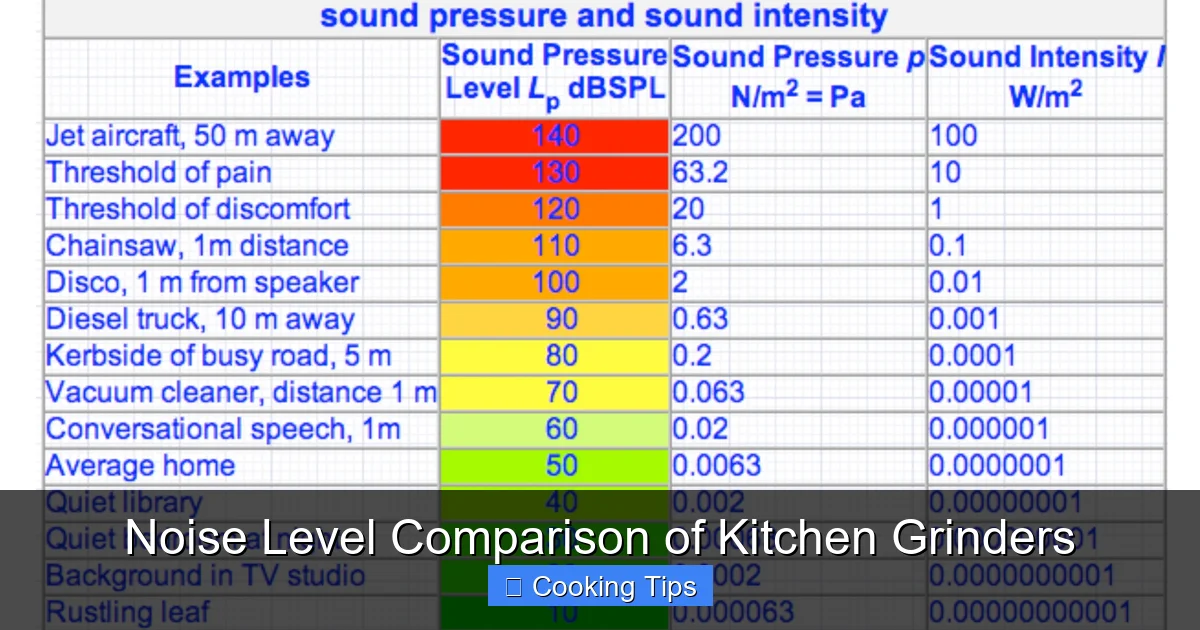
This guide helps you navigate the often-overlooked aspect of kitchen grinder noise. Learn how to measure, compare, and select a grinder that suits your auditory comfort. We cover factors influencing noise and provide practical tips to ensure your grinding experience is as pleasant as the results. Understand decibel levels and make an informed choice for a quieter kitchen.
# Noise Level Comparison of Kitchen Grinders
Welcome to the ultimate guide on comparing the noise levels of kitchen grinders! Are you tired of the ear-splitting roar of your coffee grinder interrupting your morning peace? Do you find yourself wincing every time you need to grind spices for a recipe? You’re not alone! Many people focus on the grinding power, consistency, and ease of cleaning when choosing a kitchen grinder, but the noise level is often a significant, yet overlooked, factor.
In this comprehensive guide, we’ll empower you to make an informed decision. You’ll learn what makes grinders noisy, how to measure that noise, and what to look for when comparing different models. We’ll break down the science behind sound, explore the types of grinders and their inherent noise characteristics, and provide actionable tips to find a grinder that lets you enjoy your culinary creations without the cacophony. Get ready to transform your grinding experience from a disruptive event into a harmonious part of your kitchen routine.
## Understanding Sound: The Basics of Decibels
Before we dive into grinder specifics, let’s get a grasp on how sound is measured. The unit we use to quantify sound intensity is the **decibel (dB)**. Think of decibels as a scale that tells you how loud something is.
### What Decibel Levels Mean
It’s helpful to have some reference points:
* **0 dB:** The threshold of human hearing. You can barely perceive it.
* **20 dB:** A quiet whisper. Very peaceful.
* **30 dB:** A quiet library. Still very calm.
* **40 dB:** A quiet conversation. You can easily talk over it.
* **50 dB:** A refrigerator humming. A typical background noise.
* **60 dB:** Normal conversation. Lively but not overwhelming.
* **70 dB:** A vacuum cleaner. Noticeable and can be a bit intrusive.
* **80 dB:** A garbage disposal or a garbage truck passing by. Definitely loud.
* **90 dB:** A lawnmower. Requires shouting to be heard. Prolonged exposure can be harmful.
* **100 dB:** A motorcycle or a power drill. Very loud and potentially damaging over time.
* **120 dB:** A rock concert or a jet engine at close range. Extremely loud and instantly damaging.
When comparing kitchen grinders, you’ll typically see noise levels ranging from around 60 dB to over 100 dB. A grinder operating at 70 dB is significantly louder than one at 60 dB. The difference might seem small numerically, but it’s a substantial increase in perceived loudness.
### Factors Affecting Perceived Loudness
Several factors influence how loud a grinder seems:
* **Frequency:** High-pitched noises can be more irritating and seem louder than low-pitched noises of the same decibel level.
* **Duration:** A short burst of noise is less bothersome than continuous noise.
* **Environment:** A grinder in a small, echoey kitchen will sound louder than the same grinder in a large, carpeted space with soft furnishings. This is similar to how different heat levels can affect cooking – for instance, the best heat level for frying at home might sound different depending on the pan and ambient kitchen sounds.
## Types of Kitchen Grinders and Their Noise Characteristics
The type of grinder you choose has a profound impact on its noise output. Broadly, kitchen grinders fall into two main categories: blade grinders and burr grinders.
### Blade Grinders
Blade grinders are the more common and typically more affordable option. They work by using a spinning blade (similar to a small blender) to chop and grind ingredients.
* **How They Work:** A high-speed motor spins sharp blades, creating an abrasive action that breaks down beans, spices, or herbs.
* **Noise Profile:** Blade grinders are notorious for being loud. The high-speed spinning blade, combined with the impact of ingredients being chopped, creates a significant amount of noise. Many models can easily reach **85-100 dB**, sometimes even higher. This is comparable to the sound of a lawnmower or a power drill, making them quite disruptive.
* **Pros:** Inexpensive, versatile (can grind spices, herbs, nuts, seeds, and coffee beans), compact.
* **Cons:** Inconsistent grind size, tendency to overheat, and, of course, very noisy.
### Burr Grinders
Burr grinders offer a more sophisticated and quieter grinding experience. They use two abrasive surfaces (burrs) to crush beans or spices into a consistent size.
* **How They Work:** Ingredients pass between two revolving abrasive surfaces (burrs). The distance between the burrs can be adjusted to control the coarseness of the grind.
* **Noise Profile:** Burr grinders are generally much quieter than blade grinders. Because they crush rather than chop, the action is more controlled and less jarring. Noise levels typically range from **60-80 dB**. This is closer to the sound of normal conversation or a refrigerator, making them a far more pleasant option for daily use.
* **Types of Burr Grinders:**
* **Conical Burr Grinders:** Feature cone-shaped burrs. Often considered quieter and more efficient than flat burr grinders. They produce less heat, which is beneficial for coffee beans to preserve flavor.
* **Flat Burr Grinders:** Use two flat, circular burrs. They can be very precise but may generate slightly more heat and noise than conical burrs.
* **Pros:** Consistent grind size (essential for brewing great coffee and achieving uniform spice flavors), less heat generation, quieter operation, more durable.
* **Cons:** More expensive, can be larger and heavier, require more maintenance.
## Factors That Influence a Grinder’s Noise Level
Beyond the basic type, several other design and performance factors contribute to how loud a grinder is.
### Motor Power and Speed
* **Power:** Grinders with more powerful motors often operate at higher speeds. While more power can mean faster grinding, it also typically means more noise. The motor itself generates vibrations and sound.
* **Speed:** Higher RPMs (revolutions per minute) for the blades or burrs usually result in increased noise. Manufacturers sometimes use higher speeds for quicker results, but this comes at the cost of sound.
### Build Quality and Materials
* **Housing:** A grinder with a sturdy, well-built housing made from durable materials like stainless steel or high-quality plastic will tend to vibrate less and therefore be quieter than one with flimsy construction.
* **Vibration Dampening:** Some higher-end grinders incorporate rubber feet or internal dampening mechanisms to absorb vibrations and reduce the transmission of sound.
* **Sealing:** A well-sealed unit can help contain the noise generated by the grinding process. Loose-fitting parts or gaps can allow sound to escape more easily.
### Grind Capacity and Design
* **Capacity:** While not a direct cause of noise, larger capacity grinders often house larger, more powerful motors, which can contribute to higher noise levels.
* **Grinding Chamber Design:** The shape and material of the grinding chamber can influence acoustics. Some designs might amplify sound more than others.
## How to Compare Kitchen Grinder Noise Levels
Now that you understand the factors involved, let’s look at how you can practically compare noise levels when shopping for a grinder.
### Step 1: Check the Product Specifications
The most straightforward way to compare is to look at the manufacturer’s advertised noise level.
### 2. Look for the Decibel Rating (dB)
* **Where to Find It:** This information is usually found in the product specifications section on the manufacturer’s website or on retailer product pages.
* **What to Look For:** As discussed earlier, aim for lower dB ratings. Anything below 70 dB is generally considered quiet. If a specific dB rating isn’t listed, you’ll need to rely on other indicators and reviews.
### Step 3: Read In-Depth Reviews and Watch Video Demonstrations
Specifications can be helpful, but real-world performance is what matters.
### 2. Seek Out Detailed Reviews
* **User Reviews:** Pay close attention to what users say about noise. Look for consistent comments mentioning how loud or quiet a grinder is.
* **Professional Reviews:** Tech reviewers and culinary experts often conduct detailed tests, including noise measurements or subjective descriptions of sound. They might even compare it to common household appliances.
### 3. Watch Video Demonstrations
* **YouTube and Retailer Videos:** Many product videos demonstrate the grinder in action. While the audio quality of videos can vary, you can often get a good sense of the noise level by listening carefully. Some reviewers even use sound meters in their videos.
### Step 4: Consider the Grinder Type and Brand Reputation
* **Blade vs. Burr:** As established, burr grinders are almost always quieter than blade grinders. If quiet operation is a high priority, lean towards burr models.
* **Brand Reputation:** Some brands are known for producing quieter appliances. Research brands that have a good track record for quality and user satisfaction regarding noise levels.
### Step 5: If Possible, Test it Yourself
* **In-Store Demos:** If you’re shopping in a brick-and-mortar store, ask if you can hear a demonstration model. This is the best way to get a true sense of the sound.
* **Return Policies:** Check the return policy of online retailers. If a grinder is unacceptably loud, you’ll want the option to return it.
## Practical Tips for Choosing a Quieter Grinder
Armed with knowledge, here are some practical tips to guide your purchase:
### Prioritize Burr Grinders for Quietness
If noise is a major concern, especially for daily use like grinding coffee, invest in a burr grinder. While more expensive, the quieter operation and superior grind quality are often worth it.
### Look for “Quiet Operation” Features
Some manufacturers specifically market their grinders as being quiet. While this can be a marketing ploy, it’s often backed by design choices aimed at reducing noise. Look for features like motor insulation or anti-vibration feet.
### Consider Your Usage Habits
* **Coffee Grinding:** If you grind coffee beans every morning and live with others or have sensitive hearing, a quiet burr grinder is essential.
* **Spice Grinding:** If you only grind spices occasionally, a slightly louder blade grinder might be acceptable, especially if budget is a primary concern.
* **Shared Living Spaces:** In dorms, apartments, or houses with thin walls, noise levels become even more critical.
### Don’t Just Look at CFM (for blenders, but relevant for motor power)
While not directly applicable to grinders in the same way as blenders (which might list CFM – cubic feet per minute), the general principle of motor power applies. However, focus on the *dB rating* for noise, not just raw power, as high power doesn’t always equate to extreme noise if the grinder is well-engineered.
### Read Reviews Critically
When reading reviews, look for specific comparisons. Does the reviewer say, “It’s louder than my old one” or “It’s as loud as a vacuum cleaner”? These comparisons are more helpful than generic statements.
## Troubleshooting Noisy Grinders
Sometimes, even a grinder that wasn’t initially excessively noisy can start to develop issues.
### Grinder is Louder Than Usual
* **Check for Loose Parts:** Ensure all components, like the grinding chamber, lid, and base, are securely attached.
* **Clean the Grinder Thoroughly:** Food debris or buildup can sometimes interfere with moving parts, causing increased noise. Refer to your manual for cleaning instructions. For example, keeping appliances clean is as important as using the correct ratio of water to rice in a rice cooker for optimal performance.
* **Inspect the Blades/Burrs:** For blade grinders, ensure the blades are not damaged or dull, which can cause them to work harder and be noisier. For burr grinders, check for any obstructions or damage to the burrs. If you suspect issues, consider how to fix a kitchen grinder that is not turning on or consult a professional.
* **Motor Issues:** If the noise is accompanied by a burning smell or the motor struggling, there might be a more serious motor issue.
### Unusual Grinding Sounds
* **Foreign Objects:** Ensure no foreign objects (like small stones in coffee beans) have entered the grinding chamber.
* **Worn Bearings:** A rattling or grinding noise could indicate worn bearings in the motor. This is often a sign that the grinder is nearing the end of its lifespan.
## Conclusion: Grinding Peacefully
Choosing a kitchen grinder based on its noise level is a smart move towards a more enjoyable kitchen experience. By understanding decibels, the differences between blade and burr grinders, and the factors that contribute to sound, you’re well-equipped to make an informed decision. Prioritize burr grinders for quiet, consistent results, and always refer to specifications and real-world reviews when comparing models. Don’t let a noisy grinder disrupt your mornings or your cooking sessions. Invest in a grinder that delivers the performance you need with the peace you deserve. Happy grinding!
- Noise is Measured in Decibels (dB): Understanding decibel levels is crucial. Lower dB ratings indicate quieter operation, making them ideal for noise-sensitive environments.
- Grinder Type Matters: Blade grinders are generally louder than burr grinders due to their high-speed spinning blades, while burr grinders offer more consistent results and quieter operation.
- Motor Power and Speed Affect Noise: More powerful motors and faster speeds often translate to higher noise levels. Consider a balance between performance and quietness.
- Build Quality and Materials Impact Sound: Sturdy construction, vibration-dampening materials, and a well-sealed design can significantly reduce noise output.
- Testing is Key: While specifications are helpful, listening to a grinder in action (if possible) or checking detailed reviews with sound tests provides the most accurate assessment of its noise level.
- Consider Your Environment: Your kitchen’s acoustics and your tolerance for noise will influence which grinder is best for you.
