

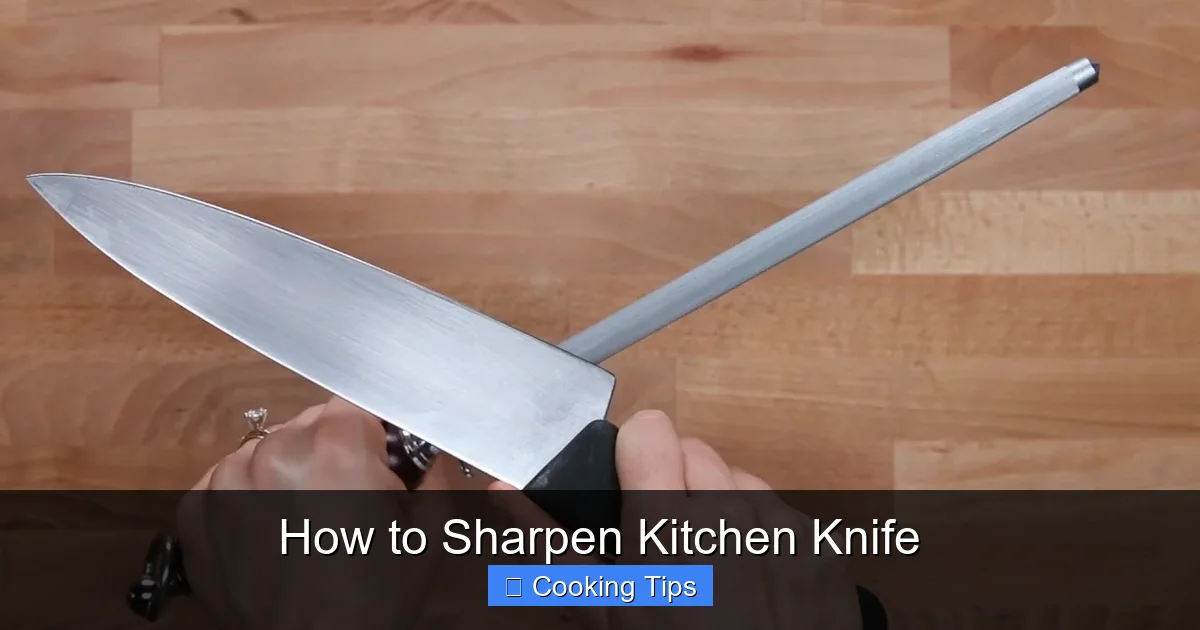
Unlock the secret to effortless food prep by learning to sharpen your kitchen knives properly. This guide provides step-by-step instructions for using sharpening stones and honing steels to achieve a razor-sharp edge, transforming your cooking experience. Say goodbye to dull knives and hello to precision and safety in the kitchen.
Key Takeaways
- Understanding Knife Sharpness: A sharp knife is safer and more efficient than a dull one, reducing the risk of slips and making food preparation a breeze.
- Sharpening vs. Honing: Learn the crucial difference between sharpening (removing metal to create a new edge) and honing (realigning an existing edge).
- Choosing the Right Tools: This guide will help you select the best sharpening stones (whetstones) or electric sharpeners for your needs.
- Mastering the Technique: Follow clear, step-by-step instructions for achieving the correct angle and consistent strokes on your sharpening stone.
- Maintaining the Edge: Discover how to properly hone your knife regularly to keep it sharp between sharpenings.
- Knife Care and Storage: Learn essential tips for proper knife cleaning and storage to preserve their sharpness and longevity.
How to Sharpen Kitchen Knife
Welcome to the ultimate guide on transforming your dull kitchen knives into precision cutting tools! Many home cooks struggle with knives that have lost their edge. This isn’t just frustrating; it can also be dangerous. A dull knife requires more pressure to cut, increasing the likelihood of it slipping and causing injury. But don’t worry! With a little knowledge and practice, you can learn to sharpen your kitchen knives effectively, making your cooking experience safer, more enjoyable, and significantly more efficient.
In this comprehensive guide, we’ll break down the process of sharpening your kitchen knives. We’ll cover everything you need to know, from understanding why sharp knives matter to choosing the right sharpening tools and mastering the techniques. By the end, you’ll be able to maintain a razor-sharp edge on all your culinary blades.
Why Sharp Knives Matter
Before we dive into the “how,” let’s quickly touch upon the “why.” A sharp knife is a cook’s best friend.
* Safety: This is paramount. A sharp knife glides through food with minimal effort. A dull knife requires you to force it, making slips far more probable, especially when cutting tough or slippery ingredients.
* Efficiency: Chopping, slicing, and dicing become quicker and easier with a sharp blade. You’ll spend less time wrestling with your ingredients and more time enjoying the cooking process.
* Precision: Achieve cleaner cuts for better presentation and more even cooking. Think perfectly diced onions or thinly sliced tomatoes – sharp knives excel at this.
* Preserves Food Integrity: A clean cut from a sharp knife won’t bruise or tear delicate ingredients like herbs or delicate fish, preserving their texture and flavor.
Sharpening vs. Honing: What’s the Difference?
It’s essential to understand the distinction between sharpening and honing. They are often used interchangeably, but they serve different purposes.
* Sharpening: This process involves removing a small amount of metal from the blade’s edge to create a new, sharp bevel. You sharpen a knife when its edge becomes noticeably dull and can no longer be restored by honing.
* Honing: This is a maintenance task. Honing realigns the microscopic teeth along the blade’s edge that have become bent or curled during normal use. Honing doesn’t remove metal; it simply straightens the existing edge. Think of it like straightening a bent comb.
You should hone your knife regularly, ideally before or after each use. Sharpening is done less frequently, perhaps every few months, depending on how often you use your knives and what you cut.
Choosing Your Sharpening Method
There are several ways to sharpen a knife, each with its pros and cons. We’ll focus on the most common and effective methods for home cooks.
1. Sharpening Stones (Whetstones)
Sharpening stones are a time-tested and highly effective method for achieving a superior edge. They come in various materials, grits, and types.
* **Types of Stones:**
* Water Stones: These are the most popular choice for many chefs. They are made of softer materials that create a slurry (a mixture of water and stone particles) as you sharpen. This slurry helps to lubricate the stone and carry away metal particles. They cut quickly and produce a very sharp edge.
* Oil Stones: These stones require oil as a lubricant. They tend to cut slower than water stones but can also produce a very fine edge.
* Diamond Stones: These have a surface of industrial diamonds bonded to a metal plate. They are very aggressive cutters and don’t require soaking or lubrication (though water can be used). They are excellent for very hard steels and are extremely durable.
* Grit Levels: Stones are graded by grit, which refers to the coarseness of the abrasive particles.
* Coarse Grit (100-400): Used for repairing chips or reshaping severely dull knives.
* Medium Grit (500-1500): For general sharpening and restoring a good edge. This is often the primary grit you’ll use.
* Fine Grit (2000-4000+): For refining the edge and making it incredibly sharp and polished.
* Polishing Stones (6000+): Used for achieving a mirror-like finish and a razor-sharp, burr-free edge.
* Combination Stones: Many sharpening stones come as combination stones, featuring two different grits on opposite sides (e.g., 1000/6000). This is a convenient and cost-effective option for home use.
2. Electric Knife Sharpeners
Electric sharpeners offer a fast and convenient way to sharpen knives. They have slots with grinding wheels that move at specific angles.
* **Pros:** Speed and ease of use. Minimal technique is required.
* **Cons:** They can remove more metal than manual sharpening, potentially shortening the lifespan of your knife if used improperly or too often. They also offer less control over the angle, which might not be ideal for high-end knives.
For this guide, we will focus on the traditional and most rewarding method: using sharpening stones.
Gathering Your Sharpening Tools
To sharpen your knives using stones, you’ll need:
* A Sharpening Stone: A combination stone (e.g., 1000/6000 grit) is an excellent starting point for most home cooks.
* Water (for water stones): A small bowl or a tap.
* A Stone Holder or Damp Cloth: To prevent the stone from slipping on your countertop.
* Your Knife: Clean and dry.
* A Towel: For wiping the blade.
Step-by-Step: Sharpening Your Kitchen Knife with a Whetstone
This is where the magic happens! Don’t be intimidated; patience and practice are key.
Step 1: Prepare Your Sharpening Stone
If you’re using a water stone, it needs to be soaked.
* **Submerge the Stone:** Place the sharpening stone in a bowl of water or run it under a tap. Let it soak until bubbles stop rising from the surface. This usually takes about 5-10 minutes for new stones, and less for stones that have been used.
* **Lubrication is Key:** Once soaked, place the stone on a stable surface. A stone holder is ideal for this as it provides grip and stability. If you don’t have a holder, place a damp cloth or paper towel underneath the stone to prevent it from sliding.
* **Maintain Wetness:** Keep the surface of the stone wet throughout the sharpening process by splashing on more water as needed. You’ll see a paste-like slurry form – this is good!
Step 2: Determine the Correct Angle
This is arguably the most crucial step for achieving a sharp edge. Most Western-style kitchen knives have an edge angle of around 20 degrees per side. Japanese knives often have a steeper angle, around 15 degrees.
* Visual Guide: Imagine slicing a thin piece off the stone. The angle at which you hold the knife should be about the width of two stacked quarters or roughly the width of your pinky finger when placed flat on the stone.
* Using an Angle Guide: If you find it difficult to maintain a consistent angle, you can purchase small angle guides that clip onto the spine of your knife.
Step 3: Sharpen the First Side of the Blade
Start with the coarser grit (e.g., the 1000 grit side of your combination stone).
* **Position the Knife:** Place the heel of the blade (the part closest to the handle) onto the stone at your chosen angle (e.g., 20 degrees).
* **The Stroke:**
* Apply light to moderate, consistent pressure.
* Draw the blade across the stone in a smooth, sweeping motion, moving from heel to tip. Imagine you’re trying to slice off a thin layer of the stone.
* Ensure the entire edge of the knife from heel to tip makes contact with the stone during the stroke.
* **Repetition:** Repeat this stroke 5-10 times, or until you feel a slight “burr” forming on the opposite side of the blade.
* **What is a Burr?** A burr is a tiny, wire-like lip of metal that forms on the opposite edge of the blade when you’ve ground enough metal away. You can feel it by carefully running your fingertip (away from the edge!) along the opposite side of the blade. It will feel slightly rough or “catchy.” This indicates you’ve reached the apex of the edge.
Step 4: Sharpen the Second Side of the Blade
Now, you’ll sharpen the other side of the knife to create a symmetrical edge.
* **Flip the Knife:** Carefully flip the knife over, maintaining the same angle.
* **Repeat Strokes:** Perform the same number of strokes (5-10) on this side, again moving from heel to tip, ensuring you remove the burr that formed on the other side. You should feel the burr diminish as you sharpen this side.
Step 5: Refine the Edge with a Finer Grit
Once you’ve established an edge on the coarser grit and removed the burr, switch to the finer grit side of your stone (e.g., 6000 grit).
* **Repeat the Process:** Follow the exact same steps as above (Steps 3 and 4) on the finer grit stone. Use lighter pressure and fewer strokes (e.g., 5 strokes per side).
* **Purpose:** This step polishes the edge, making it much sharper and smoother. It further refines the burr until it’s virtually non-existent.
Step 6: Remove the Burr (Stropping)**
To get that razor-sharp finish, you need to remove any remaining microscopic burr.
* **Light Strokes:** On the finest grit stone, use very light pressure and perform alternating strokes, one per side. Start with the heel, then the middle, then the tip. Make just 2-3 strokes per side.
* **Alternative (Optional):** Some people use a leather strop (often treated with a polishing compound) for this final step, mimicking a barber’s straight razor sharpening. This is highly effective for achieving an extremely keen edge.
Step 7: Test the Sharpness
How do you know if you’ve succeeded?
* **The Paper Test:** Hold a piece of standard printer paper vertically. Try to slice through it with your knife. A sharp knife should cut through the paper smoothly, without snagging or tearing.
* **The Tomato Test:** A truly sharp knife will easily slice through the skin of a ripe tomato without crushing it.
Step 8: Clean Up**
* **Rinse the Stone:** Rinse your sharpening stone thoroughly to remove all metal particles and slurry. Let it air dry completely before storing.
* **Clean the Knife:** Wash your knife with soap and water to remove any metal residue. Dry it immediately and thoroughly.
Honing Your Knife: Maintaining the Edge
Honing is a frequent maintenance task that keeps your knife sharp between full sharpenings. You should hone your knife before or after every few uses, or whenever it starts to feel slightly less sharp.
Using a Honing Steel (Honing Rod)**
Honing steels are typically made of steel, ceramic, or diamond. For this guide, we’ll discuss using a steel or ceramic rod.
* **Prepare the Rod:** Hold the honing steel vertically, with the tip resting firmly on a stable surface (like a cutting board or countertop).
* **Determine the Angle:** Maintain the same angle you used for sharpening (around 20 degrees).
* **The Stroke:**
* Place the heel of your knife against the steel at the correct angle.
* Draw the knife down the steel in a smooth, controlled motion, moving from heel to tip, as if you were trying to slice off a sliver of the steel.
* Repeat on the other side of the steel with the other side of the blade.
* **Repetition:** Alternate sides, performing 5-10 strokes on each side. Use very light pressure – the goal is to realign the edge, not to remove metal.
* **Test:** After honing, test the knife’s sharpness using the paper test.
Troubleshooting Common Sharpening Issues
* **I can’t feel a burr:** You might not be holding the correct angle, or you’re not applying enough pressure. Increase pressure slightly and ensure the entire edge is making contact.
* **My knife still feels dull after sharpening:** You may need to spend more time on the coarser grit to establish a new edge, or you might not have fully removed the burr. Ensure you have a good burr before moving to finer grits.
* **The edge is uneven or chipped:** This often happens with very dull or damaged knives. You might need to spend more time on a coarser grit to reshape the edge before moving to finer grits. For significant chips, a professional might be needed.
* **My hands are getting cut:** Always be mindful of where your fingers are. Keep them away from the edge, and focus on smooth, controlled movements. Never rush the process.
Knife Care and Storage: Preserving Your Sharpness
Once you’ve achieved a beautiful, sharp edge, it’s important to maintain it.
* **Wash by Hand:** Never put your good kitchen knives in the dishwasher. The harsh detergents, high heat, and banging against other items will dull and damage the blade. Wash them immediately after use with warm, soapy water and dry them thoroughly.
* **Use the Right Cutting Board:** Use a wooden or bamboo cutting board. These materials are gentler on your knife’s edge than glass or stone surfaces, which can quickly dull a sharp blade.
* **Store Properly:**
* Knife Block: A classic and effective way to store knives safely.
* Magnetic Strip: A stylish and space-saving option, keeping knives easily accessible. Ensure the magnet is strong enough.
* In-Drawer Knife Organizer: Protects blades from damage and prevents accidents.
* Blade Guards (Sheaths): Useful if you store knives in a drawer without an organizer or transport them.
Conclusion**
Learning to sharpen your kitchen knives is a skill that will profoundly improve your cooking. It’s a rewarding process that transforms a potentially dangerous tool into an extension of your hand, making every culinary task more precise, enjoyable, and safe. By understanding the difference between sharpening and honing, choosing the right tools, and practicing the techniques outlined in this guide, you’ll be well on your way to maintaining a kitchen full of razor-sharp knives. Don’t let dull knives hold you back any longer – embrace the art of sharpening and experience the difference it makes!
