

Learning the proper way to hold a kitchen knife is fundamental for safety, control, and efficiency in the kitchen. This guide will teach you the most common and effective grips, essential techniques for various cuts, and crucial safety practices. Mastering these basics will transform your cooking experience, making meal preparation faster, more enjoyable, and significantly safer.
How to Hold Kitchen Knife
Welcome to the ultimate guide on how to hold a kitchen knife! Whether you’re a complete beginner in the kitchen or just looking to refine your skills, understanding the correct way to grip your most essential tool is paramount. It’s not just about making your chopping look professional; it’s about safety, efficiency, and ultimately, enjoying the cooking process more. In this guide, we’ll break down the most effective knife grips, explain why they work, and offer practical tips to help you master them. Get ready to chop, slice, and dice with confidence!
Key Takeaways
- The Pinch Grip is King: This is the most recommended and versatile grip for most kitchen tasks, offering superior control and precision.
- Thumb Placement Matters: Whether you’re using the pinch grip or another, your thumb plays a vital role in stability and guiding the blade.
- Finger Placement Dictates Control: The position of your fingers on the handle and blade directly impacts your ability to maneuver the knife safely.
- Practice Makes Perfect: Don’t expect to be a master overnight. Regular practice with different grips and cuts will build confidence and skill.
- Safety First, Always: Proper knife handling, a stable cutting surface, and a sharp knife are non-negotiable for preventing accidents.
- Grip Variations for Specific Tasks: While the pinch grip is universal, understanding alternative grips can enhance performance for certain jobs.
- The Importance of a Sharp Knife: A sharp knife requires less force, leading to cleaner cuts and reducing the risk of slips and injuries.
Why Proper Knife Grip Matters
Before we dive into the “how,” let’s touch on the “why.” A proper kitchen knife grip is the foundation of good knife skills. Here’s why it’s so important:
- Safety: This is the number one reason. A secure grip prevents the knife from slipping out of your hand, drastically reducing the risk of cuts and injuries.
- Control: When you hold a knife correctly, you have better control over the blade. This allows for more precise cuts, leading to more evenly cooked food.
- Efficiency: A well-held knife moves more smoothly and requires less effort. This makes chopping, slicing, and dicing faster and less tiring.
- Blade Longevity: Proper handling can also help protect your knife’s edge, keeping it sharp for longer.
The Pinch Grip: Your Go-To Grip
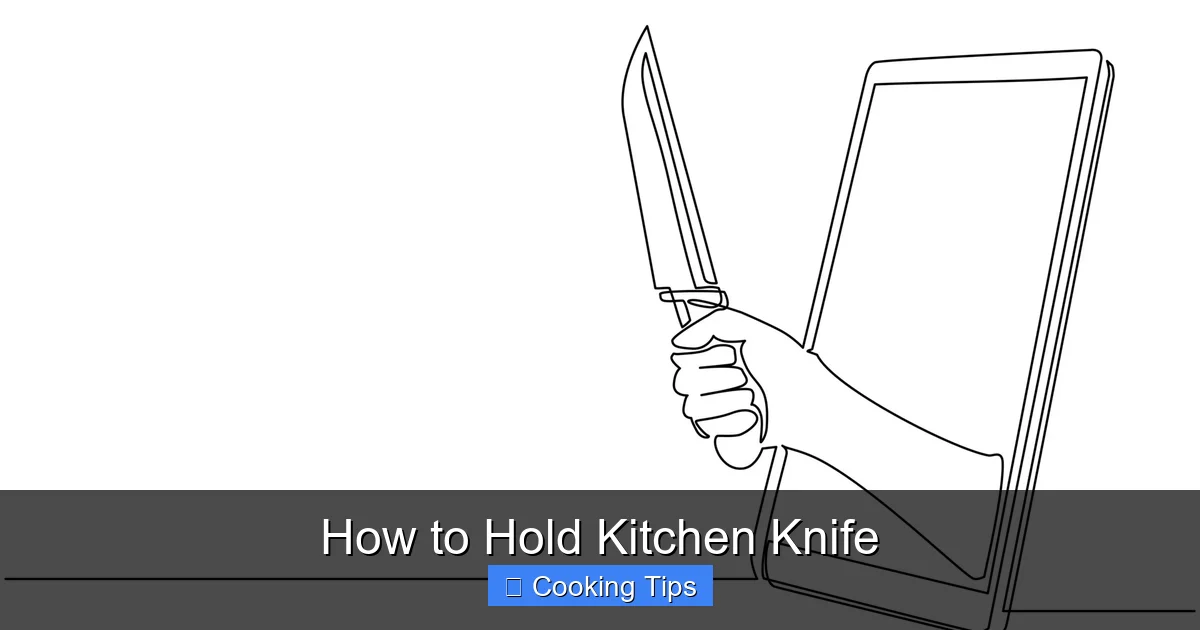
Visual guide about How to Hold Kitchen Knife
Image source: static.vecteezy.com
The pinch grip is widely considered the best and most versatile grip for most kitchen knives, especially chef’s knives and Santoku knives. It offers excellent control, precision, and comfort. Let’s break down how to achieve it.
Step 1: Identify the Blade and Handle
Before you pick up your knife, take a moment to familiarize yourself with its parts. You have the blade, which is the sharp cutting part, and the handle, which you hold. The bolster is the thick collar where the blade meets the handle.
Step 2: The Pinch
This is the core of the pinch grip.
- Place your thumb and index finger on the blade itself.
- Your thumb should rest on one side of the blade, near the bolster.
- Your index finger should curve slightly and rest on the other side of the blade, also near the bolster.
- You are essentially “pinching” the blade between your thumb and index finger.
This grip connects your hand directly to the blade, giving you the most direct control over its movement.
Step 3: The Remaining Fingers
Now, let’s address the rest of your hand.
- Curl your remaining three fingers (middle, ring, and pinky) around the handle of the knife.
- Your fingers should wrap around the handle comfortably, providing a secure base.
- Avoid gripping the handle too tightly; a firm but relaxed grip is best.
Step 4: Fine-Tuning the Pinch Grip
To get the most out of the pinch grip:
- Ensure your thumb and index finger are positioned just in front of the bolster, not too far down the blade.
- Your knuckles on the hand holding the knife should be roughly aligned with the blade.
- The goal is to have the knife feel like an extension of your arm, not something you’re just holding onto.
Practical Tip: Imagine you’re gently holding a small bird. You want to secure it without squeezing too hard. This relaxed firmness is key.
The Handle Grip: An Alternative Approach
Visual guide about How to Hold Kitchen Knife
Image source: thumbs.dreamstime.com
While the pinch grip is preferred, you might encounter or prefer a more traditional handle grip, especially with smaller knives or for certain specific tasks. This grip relies more on wrapping your fingers around the handle for support.
Step 1: Wrap Your Fingers
- Grasp the handle with your four fingers (index, middle, ring, pinky), wrapping them securely around it.
- Your index finger might extend slightly along the top of the handle or the bolster.
Step 2: The Thumb’s Role
The thumb’s position can vary here.
- Some people rest their thumb on the side of the handle.
- Others might extend their thumb along the top of the handle for added stability, similar to the pinch grip but with less direct blade contact.
Step 3: When to Use This Grip
This grip can be useful for:
- Smaller knives like paring knives or utility knives where the blade is not as long.
- Tasks that require less precision and more brute force (though good technique should minimize the need for this).
Caution: This grip generally offers less control and precision than the pinch grip, making it more prone to slippage if not executed carefully.
The Stabilizing Hand (Claw Grip)
Holding the knife correctly is only half the battle. Your other hand – the one holding the food – is equally important for safety and effective cutting. This is where the “claw grip” comes in.
Step 1: Form the Claw
- Curl your fingertips inward, tucking them under your knuckles.
- Your knuckles will then act as a guide for the side of the knife blade.
- Your thumb should be tucked in behind your fingers.
Step 2: Positioning for Cutting
- As you slice or chop, you will move your “claw” backward, inch by inch, exposing the next piece of food to be cut.
- The knife blade rests against your knuckles, preventing your fingertips from coming into contact with the sharp edge.
Step 3: Benefits of the Claw Grip
- Safety: It keeps your fingertips safely away from the blade.
- Stability: It provides a stable base for the knife to slide against, ensuring consistent cuts.
- Control: It helps you control the thickness of your slices by dictating how far the knife moves with each cut.
Practical Tip: Imagine you’re trying to get every last bit of juice from a berry. You’d gently push it with your knuckles. That’s the motion!
Basic Cutting Techniques and Grip Application
Now that you know how to hold the knife and stabilize your food, let’s apply these grips to some common cutting tasks.
1. Slicing
Slicing involves moving the knife forward and backward in a smooth motion.
- Grip: Use the pinch grip for maximum control.
- Motion: As you slice, maintain contact between the blade and your guiding knuckles (claw grip). The knife should rock up and down or move in a slight sawing motion depending on the food.
- Example: Slicing onions, tomatoes, or boneless meats. For a round object like an onion, you might use a rocking motion. For something like a bell pepper, a forward slicing motion works well.
2. Chopping
Chopping is a more downward, forceful motion, often used for ingredients that need to be in smaller pieces.
- Grip: The pinch grip is still excellent here for control.
- Motion: The blade pivots at the tip, with the heel of the blade doing most of the work. Your stabilizing hand moves the food as needed.
- Example: Chopping herbs, garlic, or celery. You might use a rhythmic up-and-down motion, moving the knife in an arc.
3. Dicing
Dicing involves creating small, uniform cubes. It’s a combination of slicing and chopping.
- Grip: Pinch grip is ideal for the precision needed.
- Motion: First, you slice the food into planks, then cut those planks into sticks, and finally, cut the sticks into cubes. Your stabilizing hand guides each step.
- Example: Dicing potatoes for hash browns or dicing carrots for a mirepoix.
Grip Variations and Specific Knives
While the pinch grip is versatile, some knives and tasks might benefit from slight adjustments.
Paring Knives
These small knives are often used for intricate tasks like peeling, trimming, and hulling.
- Grip: You might find a slightly modified pinch grip works well, or a grip where your thumb rests on the top of the blade, just above the bolster, for added control. Some chefs also prefer to wrap their fingers more around the handle for these smaller tasks, ensuring a secure hold without being overpowering.
- Why: The compact size of paring knives means you have less leverage, so direct control is key.
Bread Knives
Bread knives have a serrated edge and are designed to saw through crusty bread.
- Grip: A more traditional handle grip is often used here. The sawing motion relies more on the blade’s teeth than a precise slicing action.
- Why: The serrations do the work, and the focus is on moving the knife back and forth efficiently without applying excessive pressure that could crush the bread.
Boning Knives
Boning knives are thin and flexible, designed to get close to bones.
- Grip: A firm pinch grip is usually best for controlling the flexible blade and navigating around bones.
- Why: You need to feel the bone and control the blade’s angle precisely.
Safety First: Essential Knife Handling Tips
Mastering knife grips is crucial, but so is practicing safe habits.
- Always Use a Stable Cutting Board: A cutting board that slides is a recipe for disaster. Place a damp paper towel or a non-slip mat underneath it.
- Keep Your Knives Sharp: This sounds counterintuitive, but a sharp knife requires less force to cut, making it less likely to slip. Dull knives are more dangerous.
- Never Try to Catch a Falling Knife: Step back and let it fall. Trying to catch it is a common way to get seriously injured.
- Cut Away from Yourself: Always direct the blade’s path away from your body and hands.
- Keep Your Knives Organized: Store knives safely in a block, on a magnetic strip, or in sheaths. Don’t leave them loose in a drawer where you could reach for one and cut yourself.
- Wash Knives Separately: Wash your knives by hand, one at a time, and dry them immediately. Don’t leave them in a sink full of soapy water.
- Focus When You’re Cutting: Avoid distractions when you’re handling a sharp knife.
Troubleshooting Common Grip Issues
Even with instruction, you might run into some common problems.
Problem: My hand cramps when using the pinch grip.
- Solution: You might be gripping too tightly. Try to relax your fingers. Ensure your thumb and index finger are placed on the blade just in front of the bolster, not too far down. Sometimes, a slightly different angle of the blade relative to your hand can help.
Problem: I feel like I’m going to drop the knife.
- Solution: This often points to a lack of confidence or not having a firm enough grip. Re-evaluate your thumb and index finger placement – are they truly “pinching” the blade securely? Ensure your other fingers are providing solid support on the handle. Practice makes this feeling of insecurity disappear.
Problem: My stabilizing hand feels awkward.
- Solution: The claw grip takes practice. Ensure your fingertips are tucked in well. Move slowly and deliberately at first. Focus on keeping your knuckles as the primary guide for the blade.
Conclusion
Learning how to hold a kitchen knife properly is a fundamental skill that unlocks a world of culinary confidence and safety. The pinch grip, combined with the claw grip for your stabilizing hand, provides the best foundation for precise, efficient, and safe cooking. Remember that practice is key. Start slowly, focus on your technique, and gradually increase your speed and complexity. With consistent effort, you’ll find that your knife skills will improve dramatically, making meal preparation a more enjoyable and less intimidating part of your day. So, pick up your knife, get a good grip, and happy cooking!
