

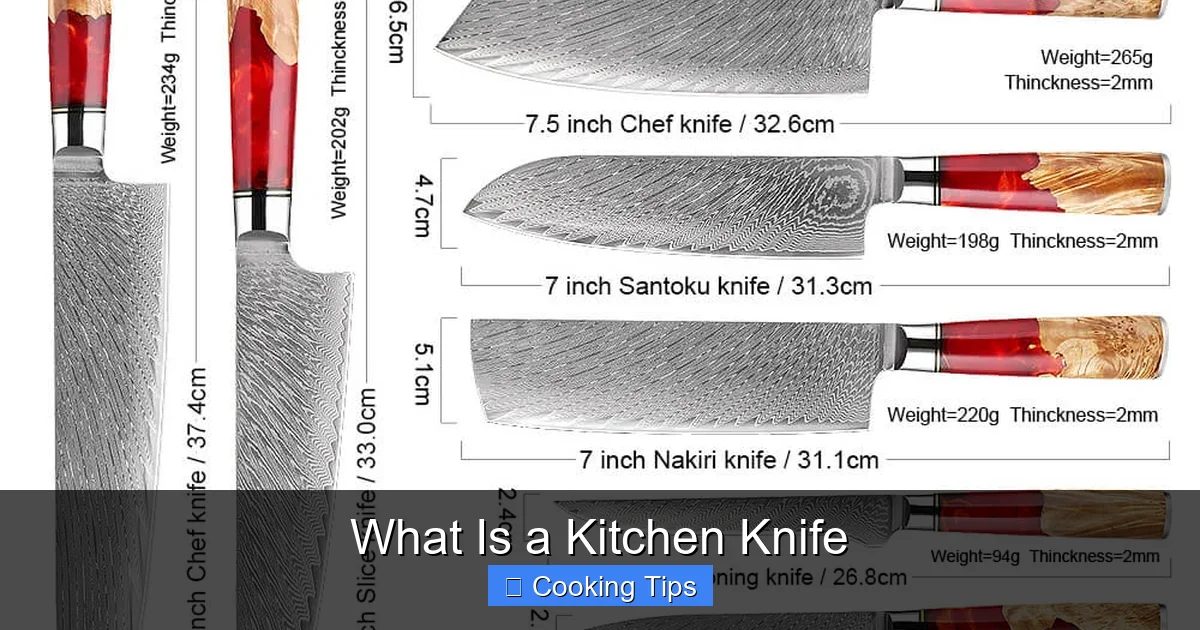
This comprehensive guide demystifies the kitchen knife, the most fundamental tool in any cook’s arsenal. We’ll explore the different types of kitchen knives, their specific uses, and provide practical advice on choosing, maintaining, and using them effectively. Mastering your knives is key to effortless and enjoyable cooking.
Key Takeaways
- A kitchen knife is a versatile cutting tool with a blade and a handle, essential for preparing food.
- Different knife types are designed for specific tasks, such as chopping, slicing, dicing, and paring.
- The chef’s knife is the workhorse, suitable for a wide range of cutting jobs.
- Proper knife care, including cleaning, drying, and sharpening, is crucial for safety and longevity.
- Choosing the right knife involves considering the task, material, balance, and handle comfort.
- Safe knife handling techniques are paramount to prevent accidents in the kitchen.
- Investing in a few quality kitchen knives will significantly improve your cooking experience.
What Is A Kitchen Knife? Your Ultimate Guide
Welcome to the heart of your kitchen! If there’s one tool that defines a cook, it’s the kitchen knife. It’s the extension of your hand, the instrument that transforms raw ingredients into delicious meals. But with so many shapes, sizes, and styles, understanding what makes a good kitchen knife can feel overwhelming. This guide is here to help. We’ll break down everything you need to know, from the basic definition to choosing your perfect blade, and keeping it in top shape. Get ready to elevate your culinary game!
Understanding the Anatomy of a Kitchen Knife
Before we dive into different types, let’s get acquainted with the parts of a kitchen knife. Knowing these components will help you appreciate their design and function.
The Blade
This is the business end of the knife. It’s typically made of steel and is the part that does all the cutting.
- Edge: The sharpest part of the blade. A well-maintained edge is crucial for safe and efficient cutting.
- Spine: The dull, unsharpened top edge of the blade. It provides rigidity and a surface for your thumb to rest on for some grip styles.
- Tip: The pointed end of the blade. It’s useful for delicate tasks like coring fruits or making precise cuts.
- Heel: The back part of the blade closest to the handle. It’s generally thicker and used for tougher chopping tasks.
- Bolster: A thick band of metal found between the blade and the handle on some knives. It adds weight, balance, and protects your fingers from sliding onto the blade.
- Tang: The part of the blade that extends into the handle. A full tang (extending the entire length of the handle) generally indicates a more durable and well-balanced knife.
The Handle
This is what you hold. A comfortable and secure handle is vital for control and preventing slips. Handles can be made from various materials like wood, plastic, or composite materials.
Why Different Kitchen Knives Exist
You might wonder why you need more than one knife. The answer is simple: specialization. Different tasks require different tools for efficiency, precision, and safety. Using the wrong knife for a job can be frustrating and even dangerous. For example, trying to slice delicate tomatoes with a heavy cleaver is impractical, just as trying to chop through thick bones with a small paring knife is ineffective.
The Essential Kitchen Knives Every Cook Needs
While the world of kitchen knives is vast, a few core types form the foundation of any well-equipped kitchen.
1. The Chef’s Knife: The All-Rounder
This is the undisputed champion of the kitchen. A good chef’s knife is your most frequently used tool.
- Description: Typically 8-10 inches long, with a broad, curved blade that tapers to a point.
- Uses: It’s incredibly versatile. You can chop, slice, dice, and mince almost anything with it – vegetables, fruits, meats, and herbs. The curved blade allows for a rocking motion, making chopping much easier.
- Tip: Look for a chef’s knife that feels balanced and comfortable in your hand. The weight should feel like an extension of your arm, not a burden.
2. The Paring Knife: For Delicate Tasks
Small but mighty, the paring knife is perfect for intricate work.
- Description: Usually 3-4 inches long with a straight, narrow blade.
- Uses: Ideal for peeling fruits and vegetables, trimming fat, deveining shrimp, or any small, detailed cutting job where a larger knife would be clumsy.
- Tip: Hold it with a firm grip. It’s often used for tasks where you’re holding the food in one hand and the knife in the other.
3. The Serrated Knife (Bread Knife): For the Uneven Cut
This knife has a saw-like edge.
- Description: Long blade with a series of teeth along the cutting edge.
- Uses: Primarily used for slicing bread, cakes, and other items with a hard crust and soft interior. The serrations grip the surface and saw through without crushing. It’s also surprisingly good for slicing ripe tomatoes or citrus.
- Tip: Use a gentle sawing motion. Don’t press down too hard, as this can squish softer items.
4. The Utility Knife: The In-Between Option
This knife falls between a chef’s knife and a paring knife in size.
- Description: Typically 5-7 inches long with a narrower blade than a chef’s knife.
- Uses: Great for slicing smaller meats, sandwiches, or larger fruits and vegetables where a paring knife is too small and a chef’s knife is too large.
- Tip: It’s a good choice for tasks where you need a bit more precision than a chef’s knife but more power than a paring knife.
Other Useful Kitchen Knives to Consider
Once you have the essentials covered, you might find these knives beneficial:
- Santoku Knife: A Japanese-style knife, similar to a chef’s knife but often with a straighter edge and a less pronounced tip. It excels at slicing, dicing, and mincing with a more up-and-down motion.
- Boning Knife: Features a thin, flexible blade designed to separate meat from bone with ease.
- Fillet Knife: Similar to a boning knife but even thinner and more flexible, perfect for filleting fish.
- Cleaver: A large, heavy knife with a broad blade, designed for chopping through bones and tough cuts of meat.
- Peeling Knife: A specialized small knife with a curved blade, designed for efficient peeling.
Choosing Your Kitchen Knife: What to Look For
Selecting the right kitchen knife can seem daunting, but focusing on a few key factors will make the process much easier.
1. Material of the Blade
The material of the blade significantly impacts its performance, durability, and maintenance.
- High-Carbon Stainless Steel: This is the most popular choice for good reason. It offers a good balance of sharpness, edge retention (how long it stays sharp), and resistance to rust and staining.
- Carbon Steel: While it can achieve an incredibly sharp edge and holds it well, it’s more prone to rust and staining. It requires diligent care and oiling.
- Ceramic: Extremely sharp and resistant to rust and staining. However, it is brittle and can chip or break if dropped or used improperly. It also cannot be sharpened by most home users.
- Damascus Steel: This refers to a layered construction technique, not a material itself. Knives made with this technique are often beautiful and can have excellent performance, but the quality varies greatly.
2. Balance and Weight
A well-balanced knife feels like an extension of your hand.
- How to Test: Hold the knife and find its natural balance point, which should ideally be at the bolster (where the blade meets the handle). If the knife feels too heavy in the blade or too light in the handle, it might not be the best fit.
- Weight: The weight should feel comfortable for the tasks you’ll perform. A lighter knife might be better for delicate slicing, while a heavier one can be good for chopping.
3. The Handle
Comfort and grip are paramount.
- Material: Wood handles can be beautiful but require more care to prevent drying or cracking. Synthetic materials like POM (polyoxymethylene) are durable and easy to clean.
- Ergonomics: The handle should fit your hand comfortably. It shouldn’t be too thick or too thin. Try holding the knife for a few minutes to see if it causes any strain.
- Grip: Ensure the handle provides a secure grip, even when wet.
4. Full Tang vs. Partial Tang
The tang is the part of the blade that extends into the handle.
- Full Tang: The metal of the blade extends all the way through the handle. This is generally preferred as it provides superior strength, durability, and balance. You’ll often see the metal of the tang running along the sides of the handle.
- Partial Tang: The metal of the blade only extends partway into the handle. These knives are typically less expensive but can be less durable.
5. Brand and Price
Reputable brands often offer higher quality and better warranties. While investing in good knives is wise, you don’t need to break the bank. Start with a few high-quality essential knives and build your collection over time.
How to Care for Your Kitchen Knives
Proper care ensures your kitchen knives remain sharp, safe, and last for years.
1. Cleaning Your Knives
This is perhaps the most critical step for knife longevity.
- Hand Wash Only: Never put your good kitchen knives in the dishwasher. The harsh detergents, high heat, and banging around can dull the blade, damage the handle, and even cause rust.
- Use Mild Soap and Warm Water: Wash the blade gently with a soft sponge and mild dish soap.
- Dry Immediately and Thoroughly: This is non-negotiable. Water left on the blade can lead to rust, especially with carbon steel knives. Use a clean, dry towel and dry both the blade and the handle completely.
2. Storing Your Knives Safely
Improper storage can damage your knives and pose a safety risk.
- Knife Block: A wooden block with slots keeps knives organized and protects the blades. Ensure the slots are wide enough to avoid rubbing the blades against each other.
- Magnetic Strip: A wall-mounted magnetic strip is a space-saving option that keeps knives visible and accessible. Ensure the magnets are strong enough to hold the knives securely.
- In-Drawer Knife Organizer: These organizers keep knives separate and protected within a drawer.
- Blade Guards: If you store knives in a drawer without a dedicated organizer, use individual blade guards to protect the edges and prevent accidents.
- Never Store Loose: Avoid throwing knives loosely into a drawer. This is dangerous and will damage your blades.
3. Sharpening Your Knives
A sharp knife is a safe knife. Dull knives require more force, increasing the risk of slipping.
- Honing Steel (Sharpening Steel): This is for *maintaining* the edge, not for truly sharpening. It realigns the microscopic teeth on the blade. Use it regularly, even daily, before or after cooking.
- How to Use: Hold the honing steel vertically. Place the heel of the knife blade against the steel at the correct angle (usually around 15-20 degrees). Draw the blade down the steel in one smooth motion, from heel to tip, applying light pressure. Repeat on the other side of the steel with the other side of the blade, alternating sides. Do this 5-10 times per side.
- Whetstones: These are for actually sharpening a dull blade. They come in various grits (coarseness). You’ll typically start with a coarser grit for dull knives and finish with a finer grit for polishing.
- How to Use: Soak the whetstone in water as per instructions. Find the correct angle (often indicated on the stone or in knife instructions). Place the blade on the stone and move it back and forth, maintaining the angle. Gradually move to finer grits.
- Electric Knife Sharpeners: These are convenient but can remove more metal than manual methods, potentially shortening the lifespan of your knives if not used carefully. Follow the manufacturer’s instructions precisely.
- Professional Sharpening: If you’re unsure or have very expensive knives, consider professional sharpening services.
Safe Knife Handling Techniques
Safety in the kitchen is paramount. Always practice safe knife handling.
- The “Claw Grip” for Food: When holding food you’re cutting, curl your fingertips under, forming a “claw.” Your knuckles act as a guide for the knife blade, protecting your fingertips.
- The “Pinch Grip” for the Knife: For most knives, especially chef’s knives, pinch the blade just in front of the bolster with your thumb and forefinger. Wrap your remaining fingers around the handle. This provides excellent control.
- Always Cut Away from Yourself: When possible, direct the knife away from your body.
- Use a Stable Cutting Board: Place a damp cloth or paper towel under your cutting board to prevent it from slipping.
- Never Try to Catch a Falling Knife: Step away. Let it fall. Trying to catch it is a common cause of serious injury.
- Keep Knives Sharp: As mentioned, sharp knives are safer.
- Focus: Pay attention when you’re using a knife. Avoid distractions.
Conclusion: Your Kitchen Knife, Your Culinary Companion
The kitchen knife is more than just a tool; it’s your essential partner in the culinary world. By understanding the different types, knowing what to look for when purchasing, and committing to proper care and safe handling, you’ll not only make your cooking easier and more enjoyable but also enhance the quality of your meals. Invest in a few good kitchen knives, learn to use them well, and they will serve you faithfully for years to come, helping you create delicious memories in your kitchen. Happy cooking!
