
Brewing exceptional pour-over coffee requires precision, and the right electric kettle is key. This guide explores the essential features of electric kettles specifically designed for pour-over, helping you choose the best electric kettle for pour-over coffee. We’ll cover temperature control, spout design, capacity, and more, empowering you to achieve the perfect extraction every time.
# Best Electric Kettle for Pour Over Coffee: Your Essential Brewing Companion
Pour-over coffee. The name itself conjures images of slow mornings, aromatic steam, and the meditative ritual of crafting a perfect cup. Unlike an automatic drip machine, pour-over puts you in complete control of the brewing process. And at the heart of this control lies one crucial tool: the electric kettle. But not just any electric kettle will do. For the nuanced art of pour-over, you need a specific type of kettle – one that offers precision, control, and consistency.
This guide is your comprehensive roadmap to finding the best electric kettle for pour-over coffee. We’ll dive deep into what makes a kettle ideal for this brewing method, explore the critical features to look for, and even offer some top recommendations. By the end, you’ll be equipped to make an informed decision and elevate your pour-over game to new heights. Forget burnt coffee or weak brews; it’s time to unlock the full potential of your beans with the perfect pour-over kettle.
## Understanding Why a Specialized Kettle Matters
Before we delve into specific features, let’s understand *why* a regular electric kettle might fall short for pour-over.
### The Limits of Standard Kettles
Most standard electric kettles are designed for one purpose: boiling water quickly. They typically have a single button to heat water to boiling point and a standard spout. While this is fine for making tea or instant coffee, it lacks the finesse required for pour-over:
* **Lack of Temperature Control:** Different coffee beans and roast levels benefit from specific water temperatures. Boiling water (212°F / 100°C) is often too hot and can scorch the coffee grounds, leading to bitter flavors. Lower temperatures might result in under-extraction and a weak, sour cup.
* **Uncontrolled Pour:** A wide, open spout on a standard kettle makes it incredibly difficult to pour water slowly and steadily. You’ll likely end up with a torrent of water, agitating the coffee grounds unevenly and creating channels where water bypasses the coffee, leading to inconsistent extraction.
### The Pour-Over Advantage
A dedicated electric kettle for pour-over coffee addresses these limitations head-on, offering features that empower you to replicate the ideal brewing conditions every single time. This translates to a cleaner, more flavorful, and consistently delicious cup of coffee.
## Essential Features of the Best Electric Kettle for Pour Over Coffee
Now, let’s break down the features that truly distinguish a great pour-over kettle from the rest.
### 1. Precise Temperature Control
This is arguably the most critical feature. The ability to set and maintain a specific water temperature is non-negotiable for optimal pour-over brewing.
* **Why It’s Crucial:**
* **Bean Specificity:** Lighter roasts generally require hotter water (around 200-205°F / 93-96°C) to extract their nuanced flavors. Darker roasts can be more delicate and may benefit from slightly cooler temperatures (around 195-200°F / 90-93°C) to avoid bitterness.
* **Consistency:** Having a kettle that accurately heats to your chosen temperature ensures you can reproduce the same excellent results batch after batch.
* **Avoids Scorching and Under-Extraction:** Too hot, and you burn the coffee. Too cool, and you don’t extract enough of the delicious soluble compounds. Precise control hits that sweet spot.
* **What to Look For:**
* **Variable Temperature Settings:** Look for kettles that allow you to select specific temperatures, often in increments of 1°F or 1°C.
* **Pre-set Temperatures:** Some kettles offer pre-set options for different types of beverages (e.g., Green Tea, Black Tea, Coffee). While not as precise as manual control, these can be a good starting point.
* **Temperature Hold Function:** This feature keeps the water at your desired temperature for a set period (often 30-60 minutes), so you don’t have to rush your brewing process.
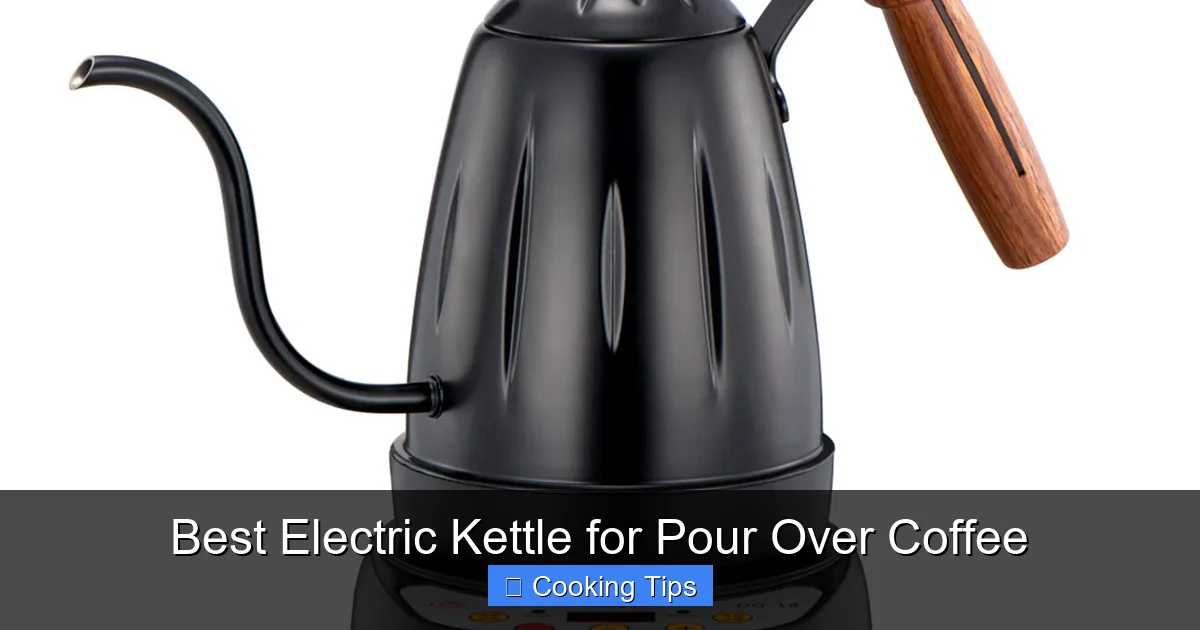
### 2. The Gooseneck Spout: Your Pouring Powerhouse
The design of the spout is the second most vital element. The “gooseneck” shape is iconic for a reason.
* **Why It’s Crucial:**
* **Controlled Flow:** The narrow, elongated neck of a gooseneck spout allows for a precise, slow, and steady stream of water. This enables you to control the rate at which water is poured.
* **Even Saturation:** You can gently saturate the coffee grounds in a circular motion, ensuring all particles are evenly exposed to water. This prevents dry pockets and encourages uniform extraction.
* **Reduced Agitation:** A controlled pour minimizes excessive agitation, which can lead to over-extraction or channeling.
* **Targeted Pouring:** You can pour water precisely where you want it, especially important for blooming the coffee (the initial pour to release CO2).
* **What to Look For:**
* **Narrow Opening:** The narrower, the better for control.
* **Angled Neck:** The distinctive curve allows for comfortable pouring at different angles.
* **Length:** A longer spout generally offers more control.
### 3. Capacity: How Much Do You Brew?
Kettle capacity refers to the maximum amount of water it can hold.
* **Why It’s Crucial:**
* **Brewing Volume:** If you typically brew only one cup at a time, a smaller kettle (0.5-0.8 liters) might be sufficient and quicker to heat. For brewing multiple cups or for a household that enjoys pour-over, a larger capacity (0.8-1.0 liters) is more practical.
* **Efficiency:** Overfilling a kettle can lead to longer heating times and potential overflow. Underfilling might require frequent refills, interrupting your flow.
* **What to Look For:**
* **Common Capacities:** Most pour-over kettles range from 0.5 liters to 1.0 liter.
* **”Max Fill” Line:** Always pay attention to the maximum fill line to avoid issues.
### 4. Material and Build Quality
The materials used in your kettle affect its durability, heating efficiency, and, importantly, the taste of your water.
* **Why It’s Crucial:**
* **Durability:** You want a kettle that will last. High-quality materials resist rust, corrosion, and general wear and tear.
* **Taste Neutrality:** The last thing you want is a metallic or plastic aftertaste from your kettle tainting your carefully brewed coffee.
* **Heating Efficiency:** Some materials conduct heat better than others, influencing how quickly your water reaches temperature.
* **What to Look For:**
* **18/8 Stainless Steel:** This is the gold standard. It’s durable, rust-resistant, easy to clean, and doesn’t impart any flavors.
* **BPA-Free Plastic:** Some kettles use BPA-free plastics for the base or lid. Ensure it’s food-grade and doesn’t feel cheap or flimsy.
* **Double-Walled Construction:** Some premium kettles feature double walls, which can help retain heat and keep the exterior cooler to the touch.
### 5. Ease of Use and Ergonomics
Beyond the core functions, consider how comfortable and convenient the kettle is to use daily.
* **Why It’s Crucial:**
* **Comfortable Handle:** A well-designed handle makes pouring easier and more stable, especially when the kettle is full.
* **Lid Design:** The lid should be easy to remove and replace, and it should fit snugly to prevent heat loss.
* **Base Stability:** The kettle should sit securely on its base.
* **Cord Storage:** Some bases have clever cord storage, keeping your countertop tidy.
* **What to Look For:**
* **Ergonomic Handle:** Try to get a feel for the handle if possible, or read reviews about its comfort.
* **Simple Controls:** Buttons should be intuitive and easy to operate.
* **Clear Water Level Indicator:** Easy-to-read markings inside or outside the kettle are helpful.
### 6. Speed of Heating and Keep Warm Functionality
While not as critical as temperature control or spout design, these features add to the overall convenience.
* **Why It’s Crucial:**
* **Morning Rush:** A kettle that heats water quickly can be a lifesaver on busy mornings.
* **Brewing Flexibility:** The “keep warm” function allows you to maintain the water at your target temperature for an extended period, giving you flexibility if you get distracted or want to brew a second cup.
* **What to Look For:**
* **Wattage:** Higher wattage generally means faster heating, but it can also draw more power.
* **Dedicated “Keep Warm” Button:** This function is a significant plus.
## Top Picks: The Best Electric Kettles for Pour Over Coffee (Examples)
While specific models change and new ones emerge, here are categories and features that often appear in highly-rated pour-over electric kettles. Always check recent reviews for the latest and greatest.
### 1. The Precision Powerhouse (High-End)
These kettles often boast advanced features like digital temperature displays, extended keep-warm functions, and extremely accurate temperature control. They are built with premium materials and offer the most refined brewing experience.
* **Key Features to Expect:** Highly customizable temperature settings, long keep-warm durations (up to an hour or more), dual-walled construction, precise gooseneck spout, premium stainless steel.
### 2. The Versatile All-Rounder (Mid-Range)
A great balance of features and price. These kettles offer reliable variable temperature control and a well-designed gooseneck spout, making them excellent choices for most home brewers.
* **Key Features to Expect:** Programmable temperature settings, good keep-warm function, sturdy stainless steel construction, good gooseneck spout, durable design.
### 3. The Budget-Friendly Champion (Entry-Level)
If your budget is tighter, you can still find excellent pour-over kettles. These might have slightly fewer customization options or a shorter keep-warm time but still deliver on the essential gooseneck spout and decent temperature control.
* **Key Features to Expect:** Preset temperature options or basic manual temperature selection, shorter keep-warm duration (or none), functional gooseneck spout, solid stainless steel build.
**Important Note:** When looking at specific models, always read user reviews. Pay attention to comments about temperature accuracy, spout control, durability, and customer service.
## How to Use Your Electric Kettle for Pour Over Coffee: A Step-by-Step Guide
Once you’ve chosen your perfect electric kettle, let’s talk about how to use it effectively for pour-over.
### Step 1: Prepare Your Coffee Beans and Grinder
* **Measure Your Beans:** Weigh your coffee beans for accuracy. A common starting ratio is 1:15 to 1:17 (coffee to water). For example, 20 grams of coffee to 300-340 grams of water.
* **Grind Your Beans:** Grind your coffee beans to a medium-fine consistency, resembling table salt or coarse sand. The grind size is crucial for extraction. Too fine, and it will clog. Too coarse, and water will pass through too quickly.
### Step 2: Heat Your Water to the Ideal Temperature
* **Fill the Kettle:** Fill your electric kettle with fresh, cold water to just above the desired amount needed for brewing. This accounts for water that will remain in the kettle and for the water absorbed by the coffee grounds.
* **Set the Temperature:** Based on your coffee beans and roast level (as discussed earlier), set your electric kettle to the target temperature. For a general medium roast, aim for around 200°F (93°C).
* **Wait for Heating:** Allow the kettle to heat the water. The “keep warm” function is handy here if you need to prep other things.
### Step 3: Prepare Your Pour-Over Device
* **Place Filter:** Insert a paper filter into your pour-over cone (e.g., Hario V60, Chemex, Kalita Wave).
* **Rinse the Filter:** Once your water is hot, pour a small amount over the paper filter to rinse away any papery taste and preheat your brewing device and carafe. Discard this rinse water.
### Step 4: Add Coffee Grounds and Bloom
* **Add Grounds:** Place your freshly ground coffee into the rinsed filter. Gently tap the side of the cone to level the coffee bed.
* **The Bloom (First Pour):** Start your timer. Slowly and evenly pour about twice the amount of water as coffee (e.g., 40 grams of water for 20 grams of coffee) over the grounds, starting from the center and working your way outwards in a spiral. Ensure all grounds are saturated.
* **Wait for the Bloom:** Let the coffee bloom for about 30 seconds. You’ll see it puff up and release CO2 bubbles. This is a critical step for even extraction.
### Step 5: The Main Pour
* **Controlled Pouring:** Resume pouring water in a slow, steady, circular motion, starting from the center and moving outwards, then back towards the center. Avoid pouring directly down the sides of the filter, as this can create channels.
* **Maintain Water Level:** Aim to keep the water level relatively consistent, not letting it get too high or too low. You can pause pouring to let the water level drop slightly before continuing.
* **Pour in Stages:** Pour in stages, allowing the water to drip through before adding more. This helps maintain an even extraction.
* **Total Brew Time:** Aim for a total brew time of about 2.5 to 4 minutes, depending on your brew device and coffee dose.
### Step 6: Finish and Enjoy
* **Let it Drip:** Once you’ve added all your water, let the remaining water drip through the coffee bed.
* **Remove Dripper:** Remove the pour-over cone once the dripping has mostly stopped.
* **Swirl and Serve:** Gently swirl the brewed coffee in the carafe to ensure consistency, then serve and enjoy your perfectly brewed pour-over.
## Troubleshooting Common Pour Over Issues
Even with the best electric kettle, you might encounter minor hiccups. Here are a few common problems and how to fix them:
### Problem: Coffee is too bitter.
* **Cause:** Over-extraction, water too hot, or grind is too fine.
* **Solution:** Try a slightly lower water temperature (e.g., reduce by 5°F/2°C). Ensure your grind size is appropriate (slightly coarser might help). Pour more slowly and deliberately.
### Problem: Coffee is too weak or sour.
* **Cause:** Under-extraction, water too cool, or grind is too coarse.
* **Solution:** Try a slightly higher water temperature (e.g., increase by 5°F/2°C). Ensure your grind size is appropriate (slightly finer might help). Pour more consistently and ensure all grounds are saturated.
### Problem: Water spills or is difficult to control from the spout.
* **Cause:** Spout opening is too wide, or you’re pouring too aggressively.
* **Solution:** This points to an issue with the kettle’s spout design. Ensure you are pouring gently and from a comfortable height. If the kettle’s spout is inherently problematic, you might need to consider an upgrade.
## Conclusion: Invest in Your Coffee Ritual
The best electric kettle for pour-over coffee isn’t just an appliance; it’s an investment in your daily ritual and the quality of your coffee. By prioritizing precise temperature control and a gooseneck spout, you gain the power to unlock the full flavor potential of your coffee beans.
Whether you’re a seasoned barista or a curious beginner, the right kettle will make a noticeable difference. It empowers you to experiment, to understand how temperature and pour rate affect taste, and ultimately, to consistently brew a cup of pour-over coffee that is truly exceptional. So, choose wisely, embrace the process, and savor every delicious sip.
Key Takeaways
- Precise Temperature Control is Paramount: Pour-over coffee thrives on specific water temperatures, making kettles with variable temperature settings essential for optimal flavor extraction.
- The Goose Neck Spout is Your Best Friend: A gooseneck spout offers superior control over your pour, allowing for a slow, steady, and precise stream of water to saturate coffee grounds evenly.
- Capacity Matters for Your Brewing Habits: Consider how much coffee you typically brew to select a kettle with an appropriate water capacity, avoiding frequent refills or wasted water.
- Material and Build Quality Influence Durability and Taste: Stainless steel or BPA-free plastic are preferred for their durability and to prevent any metallic or plastic aftertaste from affecting your coffee.
- Brew Time and Speed are Convenient Features: While not the absolute most critical, a kettle that heats water quickly and efficiently can enhance your morning coffee routine.
