

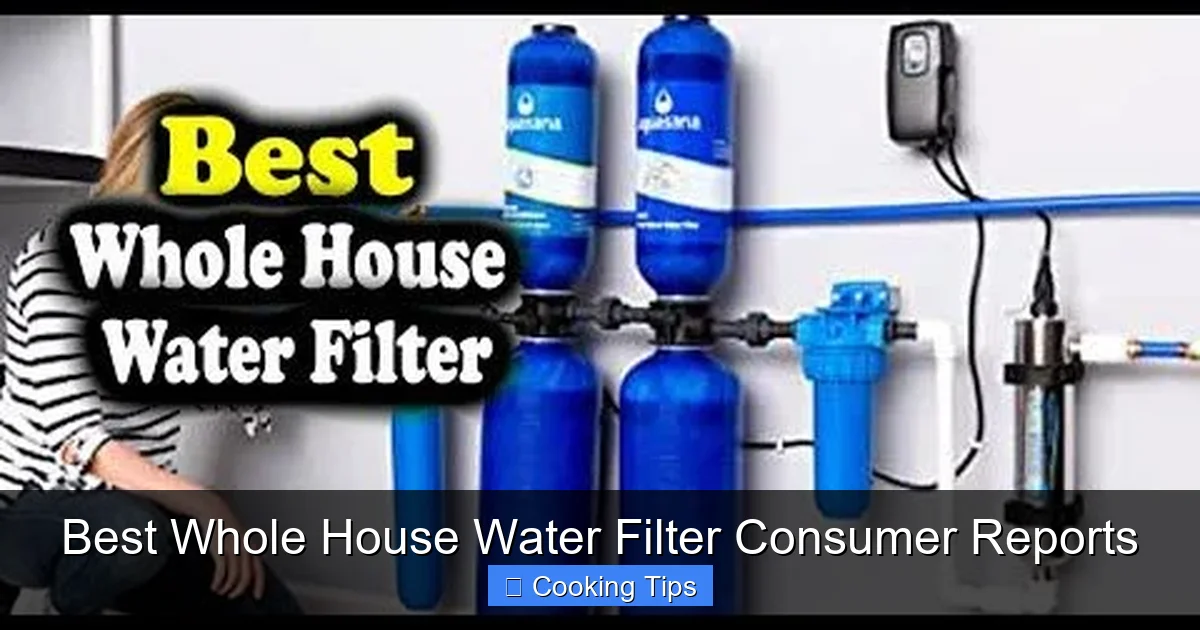
This guide delves into selecting the best whole house water filter based on Consumer Reports insights. We’ll walk you through understanding your water’s needs, comparing filter types, and making an informed purchase. Learn how to ensure cleaner, healthier water throughout your entire home for your family’s well-being.
# Best Whole House Water Filter Consumer Reports
Are you concerned about the quality of the water coming into your home? From unpleasant tastes and odors to potential health risks, tap water can sometimes be less than ideal. That’s where a whole house water filter comes in. Unlike smaller pitcher filters or faucet attachments, a whole house system treats all the water entering your residence, ensuring cleaner, safer, and better-tasting water at every tap, shower, and appliance.
But with so many options on the market, how do you choose the right one? This guide, drawing inspiration from Consumer Reports’ rigorous testing and consumer insights, will equip you with the knowledge to make the best whole house water filter decision for your needs. We’ll break down the essential steps, from understanding your water to installing and maintaining your new system, ensuring you get the most value and performance.
## Understanding Your Water: The Foundation of Your Choice
Before you even start looking at specific models, the single most important step is to understand what’s actually in your water. This isn’t a guessing game; it’s a science.
### Step 1: Get Your Water Tested
### Why Testing is Crucial
Consumer Reports consistently emphasizes the importance of independent water testing. Your local municipality provides a water quality report, which is a good starting point, but it may not reflect the specific conditions within your home’s plumbing. Private testing labs can identify a broader range of contaminants, including those that might develop as water travels through older pipes.
### How to Test Your Water
* Municipal Water Reports: Visit your local water utility’s website or contact them directly to request their latest water quality report.
* Home Water Testing Kits: These kits, readily available online and at hardware stores, allow you to collect a sample and mail it to a lab for analysis. Look for kits that test for common concerns like lead, chlorine, hardness minerals, pesticides, and volatile organic compounds (VOCs).
* Professional Water Testing Services: For the most comprehensive analysis, hire a certified water testing professional. They can perform on-site tests and provide detailed reports.
### What to Look For in Your Test Results
Pay close attention to:
* Minerals: Hardness (calcium and magnesium) can lead to scale buildup in pipes and appliances.
* Chemicals: Chlorine, chloramines, and VOCs can affect taste, odor, and health.
* Heavy Metals: Lead and copper are serious health concerns, especially for children.
* Sediment/Particulates: These can affect clarity and taste.
* Microbiological Contaminants: While less common in municipal supplies, bacteria and viruses are a concern for well water.
Knowing these specifics will directly inform the type of filter you need. For instance, if your water is very hard, you’ll need a system designed to address mineral buildup. If lead is present, a filter certified for lead reduction is essential.
## Identifying the Right Whole House Water Filter Type
Once you know your water’s profile, you can start exploring the different types of whole house water filters available. Each type excels at addressing different water issues.
### Step 2: Explore Different Filter Technologies
### Sediment Filters
* What they do: These are the most basic filters, designed to remove larger particles like sand, silt, rust, and dirt. They act as a pre-filter, protecting more advanced filters from clogging prematurely.
* When you need them: Almost everyone can benefit from a sediment filter as a first line of defense, especially if you have older pipes or notice visible particles in your water.
* How they work: They use a physical barrier (like polypropylene or pleated media) to trap particles. Filtration levels are measured in microns; lower micron ratings mean finer filtration.
### Activated Carbon Filters
* What they do: Activated carbon is highly effective at removing chlorine, chloramines, VOCs, pesticides, herbicides, and improving taste and odor.
* When you need them: If your water has a strong chemical smell or taste, an activated carbon filter is a must. It’s also excellent for general water purification.
* How they work: The porous structure of activated carbon adsorbs (attracts and holds) contaminants onto its surface. Granular Activated Carbon (GAC) and Carbon Block filters are common. Carbon block filters generally offer more thorough filtration.
### Water Softeners (Ion Exchange)
* What they do: Primarily designed to remove “hardness” minerals like calcium and magnesium. They prevent scale buildup in pipes, water heaters, and appliances, and can make soaps and detergents more effective.
* When you need them: If your water test indicates high levels of hardness, or if you notice soap scum, white spots on dishes, or stiff laundry.
* How they work: They use resin beads that attract calcium and magnesium ions and exchange them for sodium ions. This process requires periodic regeneration with salt.
### Reverse Osmosis (RO) Systems (Whole House Application)
* What they do: While often used for drinking water at a single tap, whole house RO systems are available and provide the highest level of filtration, removing a vast array of contaminants including dissolved salts, heavy metals, bacteria, and viruses.
* When you need them: If your water has extremely high levels of contaminants that other filters can’t handle, or if you desire the purest possible water throughout your home.
* How they work: Water is forced under pressure through a semi-permeable membrane that blocks almost all impurities. These systems are more complex and require more maintenance.
### Specialty Filters
* Iron Filters: Specifically designed to remove dissolved iron and manganese, which can cause staining and metallic tastes.
* UV Sterilizers: Use ultraviolet light to kill bacteria, viruses, and other microorganisms. Often used for well water or in conjunction with other filters.
* KDF (Kinetic Degradation Fluxion) Filters: Often used in combination with carbon, KDF media uses a redox process to remove chlorine, heavy metals, and inhibit bacterial growth.
**Tip:** Many whole house systems are multi-stage, combining different filter types for comprehensive treatment. For example, a common setup is a sediment filter followed by an activated carbon filter.
## Evaluating Key Features and Performance
Once you understand the types, you need to look at how well each system performs and what practical considerations are involved.
### Step 3: Assess System Performance and Practicalities
### Flow Rate and Water Pressure
* What it is: The volume of water a filter can handle per minute (gallons per minute or GPM).
* Why it matters: A filter with a low flow rate can significantly reduce the water pressure in your home, impacting your shower experience, and the efficiency of appliances like washing machines. Consumer Reports often notes how much pressure drop a system causes.
* What to look for: Ensure the filter’s rated flow rate meets or exceeds your home’s peak demand. Consider the number of bathrooms and the typical usage at any given time. A system rated for 15 GPM might be sufficient for a smaller home, while a larger household might need 20 GPM or more.
### Filter Lifespan and Replacement Costs
* What it is: How long a filter cartridge or media lasts before needing replacement or servicing.
* Why it matters: This is a significant ongoing cost. A filter that lasts longer but costs more upfront might be more economical in the long run than a cheaper filter that needs frequent replacement.
* What to look for: Check the manufacturer’s specifications for filter life (often measured in gallons or months). Calculate the annual cost of replacement filters for each system you consider. Some systems have indicator lights or gauges to let you know when it’s time for a change.
### Installation Requirements
* What it is: The process of connecting the filter system to your main water line.
* Why it matters: Whole house filters are typically installed where the main water line enters your home, after the main shut-off valve but before any branching pipes. This is usually a plumbing job.
* What to look for:
* DIY: Some simpler systems might be installable by a skilled DIYer, but it requires cutting into your main water line, which can be daunting.
* Professional Installation: Most homeowners opt for professional installation by a licensed plumber. Factor in the cost of installation, which can range from a few hundred to over a thousand dollars depending on complexity and your location.
* Space: Ensure you have adequate space for the filter housing and any associated tanks (like for water softeners).
### Certifications and Warranties
* What it is: Independent certifications and the manufacturer’s warranty on the system.
* Why it matters: Certifications from organizations like NSF/ANSI (National Sanitation Foundation/American National Standards Institute) indicate that the filter has been independently tested and verified to perform as claimed, particularly for specific contaminant reduction. A good warranty provides peace of mind.
* What to look for:
* NSF/ANSI Certifications: Look for certifications relevant to the contaminants you’re targeting (e.g., NSF/ANSI Standard 42 for aesthetic effects like taste and odor, Standard 53 for health effects like lead and VOCs, Standard 58 for RO systems).
* Manufacturer Warranty: Check the warranty period for the housing, valves, and any electronic components. Read the warranty terms carefully to understand what is covered and what voids the warranty.
## Making the Purchase and Maintaining Your System
With your research complete, it’s time to make a decision and ensure your filter continues to perform optimally.
### Step 4: Choose and Purchase Your Filter
### Compare Brands and Reviews
Consumer Reports often compiles ratings based on performance, durability, and ease of use. Beyond their reports, read customer reviews from multiple retailers to get a broad perspective on real-world performance and potential issues.
### Consider Long-Term Value
Don’t just focus on the initial price tag. Calculate the total cost of ownership, including the purchase price, installation, and the ongoing cost of replacement filters and any potential maintenance. Sometimes, a more expensive, higher-quality system can be more cost-effective over its lifespan.
### Step 5: Installation and Initial Setup
### Professional Installation is Recommended
As mentioned, professional installation is generally the safest and most reliable option. Your plumber will ensure the system is correctly connected, leak-free, and compliant with local building codes. They can also advise on the best location for installation.
### Flushing the System
After installation, it’s crucial to flush the new filter system thoroughly. This removes any manufacturing dust, carbon fines, or residual materials from the system. Follow the manufacturer’s instructions precisely for the initial flush. This can involve running water through the system for a specified period or number of gallons.
### Step 6: Ongoing Maintenance and Filter Replacement
### Follow the Manufacturer’s Schedule
This is paramount for ensuring your filter continues to work effectively and safely. Mark your calendar or set reminders for when it’s time to replace cartridges or service the system. Ignoring replacement schedules can lead to reduced filtration efficiency, potential contamination, and even damage to the system.
### Regular Inspection
Periodically inspect the filter housing for any signs of leaks, corrosion, or damage. Check any pressure gauges to ensure they are reading within the expected range.
### Troubleshooting Common Issues
* Reduced Water Pressure:
* Cause: Clogged filter, incorrect installation, or undersized system.
* Solution: Replace the filter cartridges. Ensure the filter is properly sized for your home’s flow rate. Check for kinks in the plumbing.
* Water Still Has Odor or Taste:
* Cause: Filter is exhausted, bypass valve is open, or the wrong type of filter was chosen.
* Solution: Replace the filter. Ensure all valves are in the correct “filter” position. Re-test your water and consider if a different filter technology is needed.
* Leaks:
* Cause: Loose fittings, damaged O-rings, or cracked housing.
* Solution: Tighten fittings carefully. Inspect and replace O-rings or damaged components. Contact the manufacturer or a plumber if the housing is cracked.
### Conclusion
Investing in a whole house water filter is a significant step towards ensuring healthier, cleaner water for your entire family. By following the advice inspired by Consumer Reports’ approach – starting with a thorough water test, understanding different filter technologies, evaluating performance metrics, and committing to regular maintenance – you can confidently choose the best whole house water filter for your home. This proactive approach will not only enhance your daily life through better-tasting water and improved appliance longevity but will also provide peace of mind knowing you’re protecting your loved ones from potential waterborne contaminants.
Key Takeaways
- Understand Your Water Quality: The most crucial first step is testing your water to identify specific contaminants you need to address.
- Identify Filter Types: Different whole house water filters target various issues, from sediment and chlorine to lead, VOCs, and even bacteria.
- Consider Filter Lifespan and Maintenance: Factor in how often filters need replacement or servicing and the associated costs.
- Evaluate Flow Rate and Pressure: Ensure the filter won’t significantly reduce your home’s water pressure or flow rate.
- Research Brands and Warranties: Look for reputable brands with good customer service and strong warranty policies.
- Installation Considerations: Decide whether a DIY installation is feasible or if professional plumbing is required, impacting your overall budget.
- Long-Term Cost Analysis: Beyond the initial purchase, consider ongoing filter replacement costs and potential maintenance expenses.
