

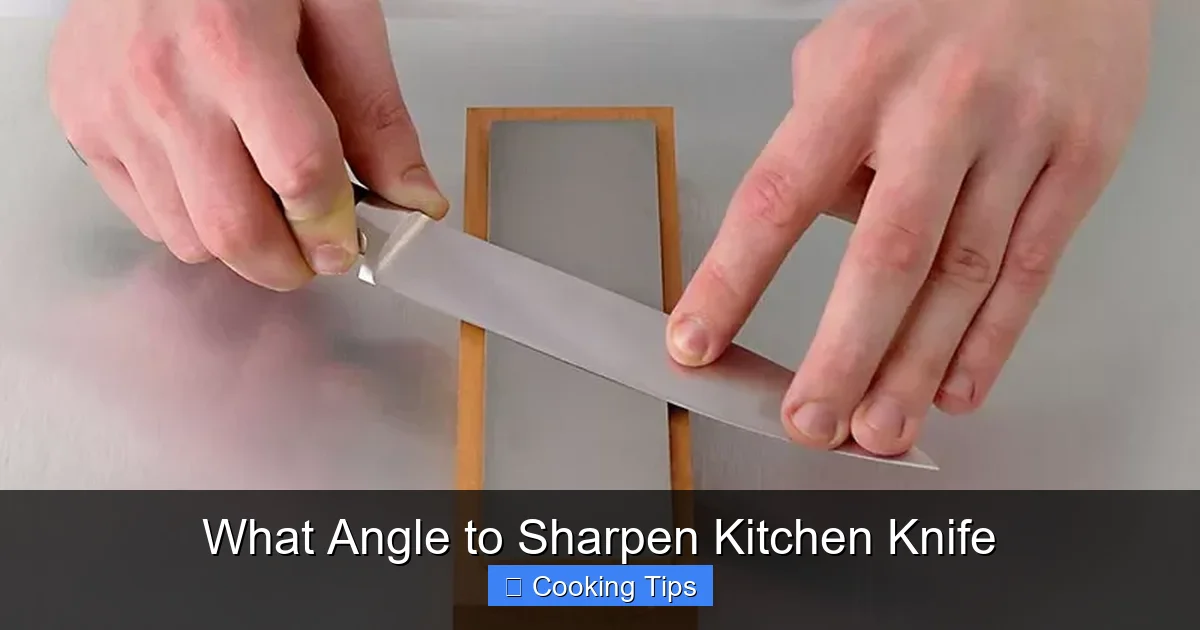
Unlock the secret to perfectly sharp kitchen knives! Understanding the right sharpening angle is crucial for effortless slicing and dicing. This guide breaks down common angles, explains how they affect performance, and provides step-by-step instructions to help you achieve a professional-grade edge. Mastering these angles will transform your cooking experience, making prep work safer and more enjoyable.
# What Angle to Sharpen Kitchen Knife
Welcome to the ultimate guide on achieving that perfect, razor-sharp edge on your kitchen knives! Are you tired of struggling with dull blades that mangle tomatoes and make chopping onions a chore? Do you find yourself pressing harder than you should, risking a slip and a cut? The secret to effortless slicing, dicing, and chopping lies not just in the quality of your knife, but in how you maintain its edge. And a huge part of that maintenance is knowing what angle to sharpen your kitchen knife.
This guide will demystify the world of knife sharpening angles. We’ll explore why angles matter, what the common angles are, and how to identify the right one for your specific knives. Whether you’re a home cook looking to improve your skills or a culinary enthusiast seeking that professional edge, you’ll leave here with the knowledge to bring your kitchen knives back to life. Get ready to transform your cooking experience!
## Why Does Sharpening Angle Matter?
Before we dive into specific angles, let’s understand why this is so important. The sharpening angle, also known as the “bevel angle,” is the angle at which the knife’s edge is ground. Think of it like the tip of a pencil. A sharper, more acute angle creates a finer point, which will be incredibly sharp and cut with less resistance. However, this fine point is also more delicate and prone to chipping or dulling quickly.
On the other hand, a wider, more obtuse angle creates a more robust edge. It’s not as slicing-sharp as a finer angle, but it’s much more durable and can withstand tougher tasks without damage.
The ideal sharpening angle for your kitchen knife is a delicate balance between sharpness and durability, tailored to the knife’s design and how you intend to use it. Using the wrong angle can lead to a knife that either dulls too quickly or is too fragile for everyday use.
## Understanding Common Knife Sharpening Angles
Most kitchen knives fall into a few common angle ranges. The vast majority of Western-style knives and many general-purpose kitchen knives are sharpened at a specific angle. Japanese knives, known for their extreme sharpness, often employ a different approach.
### Western-Style Knives: The 20-Degree Angle (or Slightly Less)
The most common sharpening angle for Western-style kitchen knives (think brands like Wüsthof, Henckels, Shun Classic, etc.) is around **20 degrees per side**. Some manufacturers even sharpen them to a slightly lower angle, around 17-18 degrees.
* What this means: A 20-degree angle provides a good compromise. It’s sharp enough for most kitchen tasks, from slicing vegetables to carving meat, and it’s durable enough to withstand the general wear and tear of a busy kitchen without frequent chipping.
* Why it’s popular: This angle is versatile. It works well for paring knives, chef’s knives, bread knives, and utility knives. It’s forgiving for home cooks and offers a reliable, sharp edge.
### Japanese-Style Knives: The 10-15 Degree Angle
Japanese knives are renowned for their exceptional sharpness and are often ground to a much more acute angle. This typically ranges from **10 to 15 degrees per side**.
* What this means: This incredibly fine angle allows Japanese knives to slice through food with astonishing ease. They are ideal for delicate tasks like filleting fish or precisely cutting delicate vegetables.
* The trade-off: The trade-off for this superior sharpness is durability. A 10-15 degree edge is more delicate. It can chip more easily if used on bones, frozen foods, or hard surfaces. Knives sharpened to this angle require more care and are best suited for precise, controlled cutting.
* Single vs. Double Bevel: It’s important to note that many traditional Japanese knives feature a single-bevel grind (like Yanagiba or Deba knives), where one side of the blade is flat and the other is ground at an angle. Western knives and many modern Japanese knives (like Gyutos) have a double-bevel grind. This guide primarily focuses on double-bevel knives, which are most common in Western kitchens.
### Serrated Knives: A Different Approach
Serrated knives (like bread knives) are a special case. Their cutting edge is not sharpened at a uniform angle like a straight edge. Instead, it consists of small “teeth.”
* What this means: Sharpening a serrated knife involves sharpening each individual tooth. The angle here is more about the specific profile of each serration. Often, a sharpening rod or a specialized serrated knife sharpener is used to address these teeth.
* When to sharpen: Serrated knives typically dull much slower than straight-edge knives. When they do, it’s often best to send them to a professional sharpener or use a specialized tool. Attempting to sharpen them with standard stones can be tricky.
## How to Determine the Right Angle for Your Knives
So, how do you figure out the ideal angle for *your* specific kitchen knives?
### 1. Check the Manufacturer’s Recommendation
The best starting point is always to consult the manufacturer of your knives. Many high-quality knife brands will specify the recommended sharpening angle for their products. This information can usually be found on their website, in the product manual, or sometimes etched onto the blade itself.
### 2. Identify the Knife’s Origin and Style
* Western-style: If your knife looks like a typical chef’s knife, Santoku, or utility knife from a well-known Western brand, it’s almost certainly designed for a 20-degree angle per side.
* Japanese-style: If you have a knife with a very thin, often harder steel blade, a delicate profile, and a designation like “Gyuto” (Japanese chef’s knife), “Santoku” (often a hybrid but can be sharpened finer), or specialized sushi knives (Yanagiba, Deba), it’s likely designed for a sharper 10-15 degree angle.
### 3. Consider the Steel Type and Hardness
Harder steels can often hold a finer edge (lower angle) without chipping. Softer steels might benefit from a slightly wider angle for better durability. However, for most home cooks, sticking to the manufacturer’s recommendation or the general guidelines for Western vs. Japanese knives is sufficient.
### 4. Think About How You Use Your Knives
* General-purpose kitchen tasks (chopping, slicing vegetables, meats): A 17-20 degree angle is excellent.
* Delicate tasks, fine slicing, precision work: A 10-15 degree angle might be preferred, but remember the increased risk of chipping.
* Heavy-duty tasks (like chopping through thick skin or cartilage): A slightly wider angle (20-22 degrees) can offer more robustness.
## How to Maintain the Correct Sharpening Angle
Achieving the correct angle is one thing; maintaining it consistently during sharpening is another. This is where practice and sometimes tools come in handy.
### Using Sharpening Stones (Whetstones)
This is the most traditional and arguably the most effective method. It involves sliding the knife’s edge across abrasive stones.
#### Step-by-Step Guide to Sharpening with Stones:
1. Prepare Your Stones: If you’re using water stones, soak them in water according to the manufacturer’s instructions until they stop releasing bubbles. Oil stones use oil as a lubricant.
2. Set Up Your Workspace: Place a damp cloth or non-slip mat under your sharpening stone to prevent it from sliding.
3. Find the Angle: This is the crucial part.
* Visualizing 20 Degrees: Imagine the angle. If you place the knife flat on the stone (0 degrees), then lift it up so it’s perpendicular (90 degrees), half of that lift is 45 degrees. Half of that is approximately 22.5 degrees. So, slightly less than that halfway point is your 20-degree target.
* Using a “Coin Method” (for 20 degrees): For a 20-degree angle, you can place about two stacked US pennies (or the equivalent thickness) under the spine of the knife when it’s flat on the stone. This helps lift the blade to the correct angle.
* Using a “Coin Method” (for 15 degrees): For a 15-degree angle, you might use just one penny or a coin of similar thickness.
* Using a “Coin Method” (for 10 degrees): This is much finer; you might use just the thin plastic packaging your knife came in, or a very thin shim.
4. Start Sharpening:
* Place the heel of the knife on the stone at your chosen angle.
* Apply gentle, even pressure.
* Drag the knife forward and across the stone, maintaining the angle, until the tip of the knife leaves the stone. This motion should create a smooth, sweeping arc.
* Repeat this motion for a set number of strokes (e.g., 10-20 strokes).
5. Flip and Repeat: Flip the knife over and repeat the same process on the other side of the blade, maintaining the identical angle.
6. Progress Through Grits: Start with a coarser grit stone (lower number, e.g., 400-1000) to establish the bevel, then move to a finer grit stone (higher number, e.g., 3000-8000) to refine and polish the edge.
7. Deburr the Edge: After sharpening, gently drag the knife very lightly across the stone at a slightly higher angle (around 25-30 degrees) to remove any “burr” (a tiny wire of metal left on the edge).
8. Test Sharpness: Carefully test the sharpness by trying to slice through a piece of paper. It should slice cleanly without tearing.
### Using Sharpening Guides and Jigs
For those struggling to maintain a consistent angle freehand, sharpening guides and jigs are invaluable.
* Angle Guides for Sharpening Stones: These small clips attach to the spine of your knife and rest on the stone, ensuring your knife stays at the correct angle as you move it. They are excellent for learning and for quick touch-ups.
* Pull-Through Sharpeners: These devices have pre-set angled slots that you pull your knife through. They are very easy to use and can restore sharpness quickly, but they remove more metal than stones and can alter the original angle over time. Many have different slots for different angles.
* Electric Sharpeners: Similar to pull-through sharpeners, electric models use abrasive wheels or belts that spin at high speeds. They are fast and convenient but can be aggressive and are not ideal for high-end knives. Choose one that offers adjustable angles if possible.
### Using a Honing Steel
While not technically sharpening, honing is *essential* for maintaining your knife’s edge between sharpenings. A honing steel (or honing rod) realigns the microscopic teeth of the blade’s edge that get bent out of alignment during normal use.
* The Angle for Honing: The angle for honing is typically the same as your sharpening angle. If you sharpen at 20 degrees, you’ll hone at 20 degrees.
* How to Hone: Hold the steel vertically or horizontally. Place the heel of the knife on the steel at the correct angle and draw it down in a smooth, sweeping motion. Repeat on the other side. A few strokes on each side are usually sufficient.
## Common Mistakes and How to Avoid Them
* Inconsistent Angle: This is the most common pitfall. A wobbling angle creates an uneven edge that dulls quickly and can chip. Solution: Use a jig, guide, or practice the “coin method” diligently. Focus on developing muscle memory.
* Too Much Pressure: Pressing too hard can damage the edge and the stone. Solution: Use gentle, consistent pressure. Let the abrasive material do the work.
* Wrong Angle for the Knife: Sharpening a Japanese knife at 20 degrees won’t give you its legendary sharpness. Sharpening a Western knife at 10 degrees might make it too delicate. Solution: Know your knife and its intended angle.
* Not Honing Regularly: Letting your knife’s edge go without honing will cause it to dull much faster and require more aggressive sharpening. Solution: Hone your knife every few uses.
* Sharpening Too Often with Aggressive Methods: Over-sharpening, especially with electric sharpeners, can shorten the lifespan of your knife by removing too much metal. Solution: Use stones for serious sharpening and a honing steel for daily maintenance.
## Conclusion: Embrace the Edge!
Mastering the art of sharpening your kitchen knives, starting with understanding the right angle, is a rewarding skill that will elevate your entire cooking experience. A sharp knife is not only more efficient but also significantly safer, reducing the risk of slips and accidents.
Remember that for most Western kitchen knives, a 20-degree angle per side is your go-to. For delicate Japanese knives, aim for a finer 10-15 degrees. Most importantly, strive for consistency. Whether you use whetstones, angle guides, or pull-through sharpeners, a steady hand and a focus on maintaining that precise angle are paramount.
Don’t be discouraged if your first few attempts aren’t perfect. Sharpening is a skill that improves with practice. Invest in good quality sharpening tools, understand your knives, and embrace the process. Soon, you’ll be slicing and dicing with newfound confidence and ease, enjoying the true pleasure of working with a perfectly sharp kitchen knife. Happy sharpening!
Key Takeaways
- The 15-20 degree angle is the most common for Western kitchen knives, offering a good balance of sharpness and durability.
- Japanese knives often benefit from a sharper, more acute angle (10-15 degrees), delivering exceptional sharpness but requiring more care.
- Consistency is more important than the exact degree; maintaining a steady angle throughout sharpening is key.
- Different knife types and intended uses dictate the ideal sharpening angle, so understanding your knives is important.
- Sharpening guides and jigs can be invaluable tools for beginners to achieve and maintain the correct angle.
- Regular honing (using a honing steel) is essential between sharpenings to realign the blade’s edge and maintain sharpness.
