

Brewing 12 cups of drip coffee at home is easy when you know the right coffee-to-water ratio. This guide will help you determine the ideal amount of coffee grounds for 12 cups, ensuring a delicious and perfectly balanced brew. We’ll cover standard ratios, adjustments for strength, and essential brewing tips. Get ready for your best coffee yet!
Are you ready to brew the perfect pot of coffee for your friends, family, or just for yourself? Making a big batch of drip coffee for 12 cups might seem straightforward, but getting the flavor just right can sometimes be a challenge. Too weak, and it’s disappointing. Too strong, and it can be bitter. This guide is here to demystify the process. We’ll walk you through exactly how much coffee you need for 12 cups of drip coffee, cover the essential ratios, and offer practical tips to elevate your home brewing game. Get ready to consistently enjoy a delicious, aromatic cup every time.
Key Takeaways
- The Golden Ratio: The standard starting point for drip coffee is a 1:15 to 1:18 coffee-to-water ratio by weight. This means for every gram of coffee, use 15-18 grams of water.
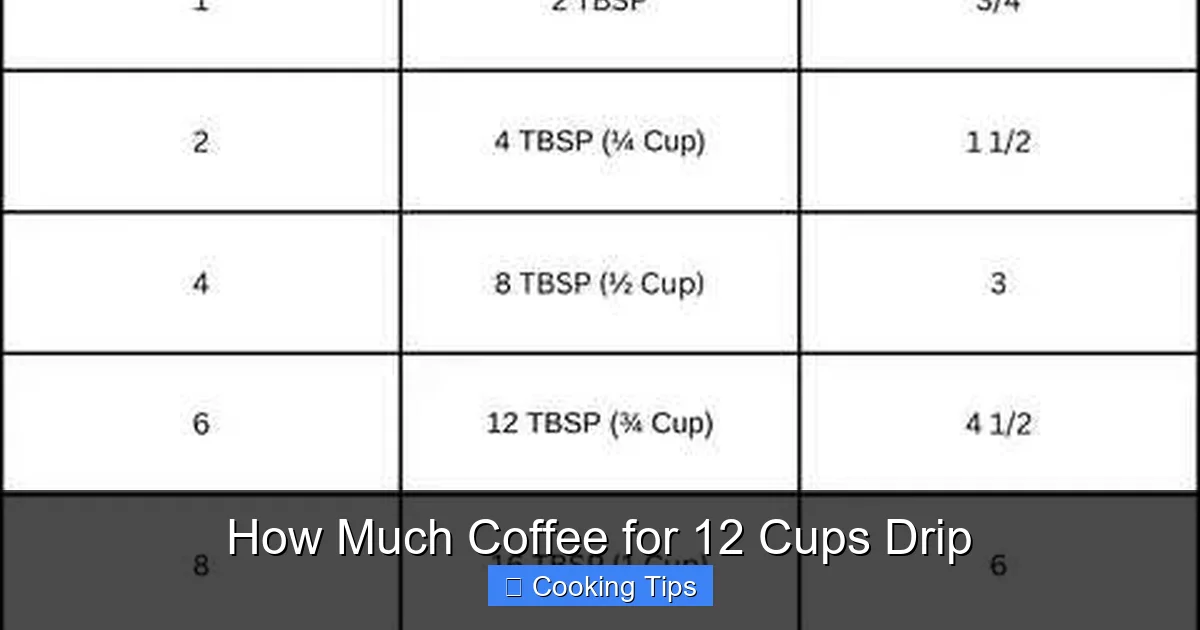
- Measuring by Volume: For convenience, a common starting point is 1-2 tablespoons of coffee grounds per 6 ounces of water. For 12 cups, this typically translates to 8-16 tablespoons of grounds.
- Adjusting Strength: If you prefer stronger coffee, increase the amount of coffee grounds. For weaker coffee, use fewer grounds. Experiment to find your personal preference.
- Water Quality Matters: Always use fresh, cold, filtered water for the best tasting coffee.
- Grind Size is Key: A medium grind is generally best for drip coffee makers. Too fine can lead to over-extraction and bitterness, while too coarse results in weak coffee.
- Freshness is Paramount: Use freshly roasted and freshly ground coffee beans for the most flavorful brew.
Understanding Coffee-to-Water Ratios
The secret to a great cup of coffee lies in the balance between coffee grounds and water. This balance is often expressed as a ratio. While personal preference plays a big role, there are established guidelines that serve as excellent starting points.
The “Golden Ratio” Explained
The Specialty Coffee Association of America (SCAA) has often cited a “golden ratio” for brewing coffee. This ratio is typically between 1:15 and 1:18. What does this mean? It refers to the proportion of coffee to water by weight. For example:
1:15 Ratio: For every 1 gram of coffee, you use 15 grams of water.
1:18 Ratio: For every 1 gram of coffee, you use 18 grams of water.
Using a scale to measure your coffee and water is the most accurate way to achieve consistent results. However, many home brewers don’t have a kitchen scale readily available.
Volume-Based Measurements: The Practical Approach
For those who prefer to measure by volume, common kitchen tools like tablespoons and cups are used. This method is less precise than weighing, but it’s much more accessible for most home cooks.
Standard Recommendation: A widely accepted starting point is 1 to 2 tablespoons of coffee grounds for every 6 ounces (about 177 ml) of water.
Most standard 12-cup coffee makers have a carafe that holds roughly 60-65 ounces of brewed coffee. It’s important to note that a “cup” in coffee maker terms is often a 5-ounce measure, not a standard 8-ounce measuring cup. This can be a source of confusion!
Calculating Coffee Grounds for 12 Cups
Let’s break down how to calculate the amount of coffee grounds needed for a 12-cup batch, using both weight and volume for clarity.
Method 1: Using Weight (The Most Accurate)
To use the golden ratio accurately, you’ll need a kitchen scale.
Step 1: Determine Total Water Weight
First, figure out how much water you’ll actually be brewing. A typical 12-cup coffee maker will brew about 60-65 ounces of liquid. Let’s assume you’re aiming for 60 ounces of brewed coffee. Since water weighs approximately 1 ounce per fluid ounce, you’ll need about 60 ounces of water.
Step 2: Choose Your Ratio
Let’s start with a 1:16 ratio.
Step 3: Calculate Coffee Weight
Water weight (60 ounces) / Ratio (16) = Coffee weight

Visual guide about How Much Coffee for 12 Cups Drip
Image source: cdn.shopify.com
60 ounces / 16 = 3.75 ounces of coffee grounds
To convert ounces to grams (since most scales measure in grams):
3.75 ounces * 28.35 grams/ounce ≈ 106 grams of coffee grounds
So, for 60 ounces of water using a 1:16 ratio, you’d need approximately 106 grams of coffee.
If you prefer stronger coffee, you might use a 1:15 ratio:
60 ounces / 15 = 4 ounces of coffee grounds
4 ounces * 28.35 grams/ounce ≈ 113 grams of coffee grounds
For weaker coffee, try a 1:18 ratio:
60 ounces / 18 ≈ 3.33 ounces of coffee grounds
3.33 ounces * 28.35 grams/ounce ≈ 95 grams of coffee grounds
Method 2: Using Volume (The Most Common)
This method uses tablespoons and is much simpler for most home users. Remember, a “cup” on your coffee maker is usually 5 ounces. For 12 “cups,” that’s 60 ounces of water.
Step 1: Standard Measurement
The generally accepted standard is 1 to 2 tablespoons of coffee grounds per 6 ounces of water. Since we’re aiming for 60 ounces (which is 10 times 6 ounces), we’ll multiply our tablespoon range by 10.
For a moderately strong brew (around 1.5 tablespoons per 6 oz):
1.5 tablespoons/6 oz * 10 (for 60 oz) = 15 tablespoons of coffee grounds
For a stronger brew (around 2 tablespoons per 6 oz):
2 tablespoons/6 oz * 10 (for 60 oz) = 20 tablespoons of coffee grounds
For a milder brew (around 1 tablespoon per 6 oz):
1 tablespoon/6 oz * 10 (for 60 oz) = 10 tablespoons of coffee grounds
Therefore, for 12 cups of drip coffee (approximately 60 ounces of water), you’ll likely need somewhere between 10 and 20 tablespoons of coffee grounds. A good starting point for most people is around 15-18 tablespoons.
Practical Tips for Brewing Delicious Coffee
Simply knowing how much coffee to use is only part of the equation. Several other factors contribute to the final taste of your brew.
Use Fresh, Quality Beans
The flavor of your coffee starts with the beans. Opt for freshly roasted whole beans. Look for a “roasted on” date on the packaging, rather than just an expiration date. Coffee is best enjoyed within a few weeks of its roast date.
Grind Your Beans Just Before Brewing
Ground coffee loses its flavor and aroma much faster than whole beans. Invest in a good burr grinder (blade grinders can produce inconsistent particle sizes, leading to uneven extraction).
Grind your beans right before you’re ready to brew.
Choose the Right Grind Size
For most automatic drip coffee makers, a medium grind is ideal. It should resemble the texture of coarse sand.
Too fine: The water will have trouble passing through the grounds, leading to over-extraction and a bitter, muddy taste. This is similar to how too fine a grind can cause issues with other kitchen appliances. For instance, if you’re dealing with a blender, a grind that’s too fine can sometimes lead to problems if it’s not meant for that purpose.
Too coarse: The water will pass through too quickly, resulting in under-extraction and a weak, sour, or watery coffee.
Water Quality is Crucial
Coffee is over 98% water, so the quality of your water significantly impacts the taste.
Use filtered water: Tap water can contain minerals, chlorine, or other impurities that can interfere with the coffee’s flavor. Using filtered water will lead to a cleaner, brighter taste.
Use cold water: Always start with cold water in your coffee maker’s reservoir. The machine is designed to heat the water to the optimal brewing temperature.
Pre-heat Your Coffee Maker and Carafe
Some coffee enthusiasts recommend pre-heating your coffee maker’s brew basket and carafe.
You can do this by running a cycle with just hot water. This helps ensure that the brewing temperature remains stable and that your coffee doesn’t cool down too quickly once it’s brewed.
Clean Your Coffee Maker Regularly
Coffee oils and mineral buildup can accumulate in your coffee maker over time, affecting the taste of your coffee and the machine’s performance.
Follow your coffee maker’s manufacturer instructions for descaling and cleaning. Regularly cleaning your coffee maker, like ensuring your appliance parts are clean, is key to good results. If your coffee maker stops working, you might find our guide on how to fix a coffee maker that will not turn on helpful.
Troubleshooting Common Coffee Brewing Issues
Even with the right measurements, sometimes your coffee might not turn out as expected. Here are a few common issues and how to fix them.
Problem: Coffee Tastes Bitter
* Cause: Over-extraction, too fine a grind, water too hot, or dirty equipment.
* Solution:
* Use a coarser grind size.
* Ensure your coffee maker heats water to the correct temperature (usually around 195-205°F or 90-96°C).
* Clean your coffee maker thoroughly.
* Try using slightly less coffee grounds or a more dilute ratio (e.g., moving from 1:15 to 1:16 or 1:17).
Problem: Coffee Tastes Weak or Sour
* Cause: Under-extraction, too coarse a grind, not enough coffee grounds, or water not hot enough.
* Solution:
* Use a finer grind size.
* Use more coffee grounds or a more concentrated ratio (e.g., moving from 1:18 to 1:16 or 1:15).
* Ensure your coffee maker is heating water properly. If you’re unsure about appliance temperatures, our guide on cooking temperature guide for beginners can offer general insights, though coffee makers have specific needs.
Problem: Coffee Tastes Muddy or Has Sediment
* Cause: Grind is too fine, or the coffee maker’s filter isn’t working properly.
* Solution:
* Ensure you are using a medium grind.
* Check your coffee filter. If you’re using a paper filter, make sure it’s the correct size and properly seated. If you use a reusable filter, ensure it’s clean.
Problem: Coffee Brews Too Slowly or Not At All
* Cause: Clogged brew basket, or the coffee maker itself is malfunctioning.
* Solution:
* Ensure the brew basket and filter are not clogged with old grounds.
* If the issue persists, it might be a problem with the coffee maker. Consult your user manual or our guide on how to fix a coffee maker that will not turn on for potential solutions.
Finding Your Perfect 12-Cup Brew
The journey to the perfect cup of coffee is a personal one. The guidelines provided here are excellent starting points, but don’t be afraid to experiment.
Start with the standard: Use about 15-18 tablespoons of coffee grounds for your 12-cup coffee maker.

Visual guide about How Much Coffee for 12 Cups Drip
Image source: cdn.shopify.com
Taste and adjust: If it’s too weak, add a little more coffee next time. If it’s too strong, reduce the amount slightly. Keep notes on what you like best.
Consider your beans: Different types of coffee beans will have different flavor profiles. A dark roast might taste stronger than a light roast, even with the same amount of grounds.
Brewing 12 cups of coffee at home should be an enjoyable ritual. By understanding the basic ratios and paying attention to quality ingredients and brewing techniques, you can consistently make a delicious pot that rivals your favorite cafe. So, measure, brew, and savor the aroma!
